
Pool volume alone does not determine a chlorine dose. You also need the current free chlorine reading, the target reading and the product's available chlorine concentration. Raising free chlorine by 1 ppm requires 1 g of available chlorine per 1,000 litres of water; the amount of granules or liquid depends on the strength stated on the label.
Written and edited by: Pool Explained editorial team
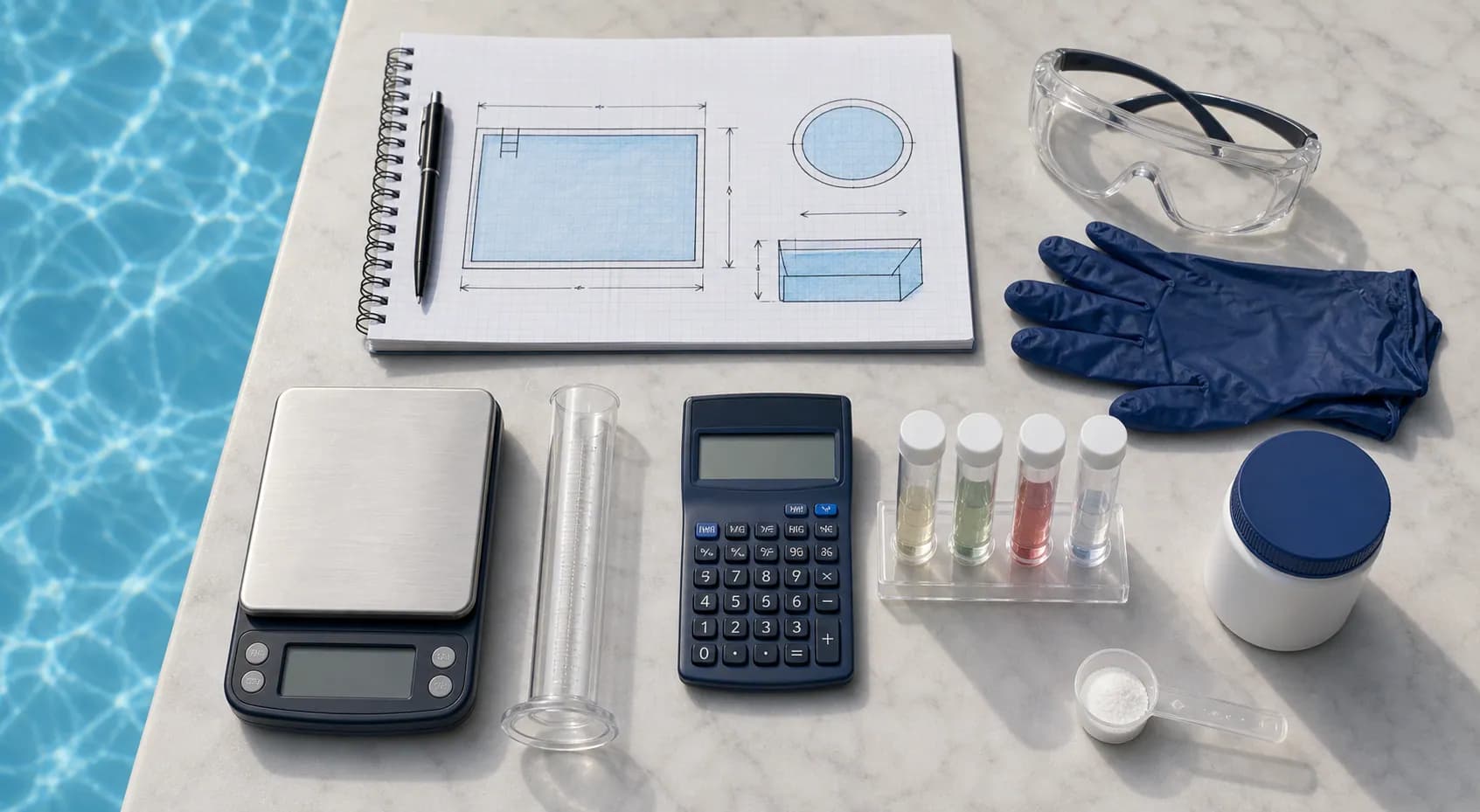
How to calculate the dose
First calculate water volume. For a rectangular pool, multiply length by width by average water depth. A pool measuring 6 × 3 m with an average depth of 1.3 m holds approximately 23.4 m³. Large steps or benches reduce the actual volume, but this gives you a starting estimate.
Next, measure free chlorine. As an arithmetic example, increasing a reading from 0.5 ppm to 1.5 ppm means adding 1 ppm. In 23.4 m³, that requires 23.4 g of available chlorine. This is not yet the weight of product to add, and 1.5 ppm is not a suitable target for every pool. Choose the target from your treatment instructions, then account for product concentration.
If the granules contain 65% available chlorine, divide 23.4 g by 0.65. The result is approximately 36 g of product. A 2 ppm increase in the same pool would require twice as much. This illustrates why doses cannot be copied from the packaging of a different product.
With liquid chlorine, check how concentration is stated. Some labels give a percentage; others give available chlorine per litre. If it is unclear, do not guess. Follow the manufacturer's dosing instructions or ask the supplier to confirm the calculation for your pool volume.
Look for available chlorine on the label, not just the product name or total pack weight. If concentration is expressed differently, use the manufacturer's dosing table. The examples here explain the arithmetic; they do not replace instructions for the product you use.
Why the daily dose changes
Sunlight breaks down chlorine in an outdoor pool. Demand also increases with warm water, more swimmers, rain, dust, leaves and cosmetics. A dose that was enough during a quiet week may not be enough after a busy day of swimming.
pH affects chlorine performance too. If pH is too high, chlorine works less effectively even when a test shows it is present. Check both readings before a large adjustment. In outdoor pools, monitor stabiliser: too little allows faster chlorine loss in sunlight, while too much makes effective chlorination harder to maintain.
For home pools, the CDC recommends at least 1 ppm free chlorine, or at least 2 ppm when cyanuric acid or stabilised chlorine is used, with pH between 7.0 and 7.8. Your product instructions and equipment requirements may be more specific. Set your target accordingly.
Slow-dissolving tablets are generally for routine chlorination, not rapid correction of a low reading. Do not place a tablet directly on the floor or liner, where it can bleach or damage the surface. Use a floating dispenser or feeder only as permitted by the chemical and equipment instructions.
How to add chlorine safely
Keep chlorine in its original, securely closed packaging in a dry, ventilated place, separate from acids, pH reducers and other chemicals. Never mix chlorine types or put chlorine and acid together in a bucket, skimmer or feeder. The mixture can release dangerous gas or react violently.
Test pH and free chlorine before dosing. Take the water sample away from return jets and chemical addition points. Use clean testing equipment and in-date reagents. If the result seems implausible, repeat the test according to its instructions before adding more chemicals.
Add the product exactly as its label describes. Some products need pre-dissolving; others go directly into the pool. Do not substitute your own method. Where pre-dissolving is permitted, use a clean container dedicated to that chemical and follow the stated order for adding water and product.
Keep swimmers out while dosing. Run circulation for the specified time, observe the waiting period and test again. Swimming can resume only when chlorine and pH are within the required ranges and the label's waiting time has passed.
When shock treatment is needed
Shock treatment is used when chlorine needs to rise quickly, for example to treat algae, address contamination after very heavy use or deal with a chloramine problem confirmed by testing. It is not a dose to add blindly every week. The amount depends on the reason for treatment, current readings, stabiliser and the product.
A strong chlorine smell and stinging eyes often indicate chloramines rather than excess free chlorine. Test free and total chlorine and act on the readings. Ventilation matters in indoor pools too. Smell alone cannot determine the dose.
For green water, shock chlorination is only part of the treatment. Brush the walls and floor, monitor and clean the filter, and remove settled debris. If the water is transparent but turned green or brown after chlorine was added, metals may be responsible. More chlorine can intensify that colour and cause stains.
After shock treatment, keep everyone out until the label's waiting time has passed and a fresh test confirms acceptable readings. Do not rely on smell or appearance. Record the dose and the next test result so you have useful information from your own pool for future treatments.