
Pool Explained
SR
Choosing a pool

Costs and budgeting

How much does a pool cost?

The price depends on where you live, what you build and what the quote includes. A basic seasonal pool and a fully installed in-ground pool are very different purchases. This guide explains what to include in your budget and how to estimate running costs with your own local prices.

Planning a complete pool budget with drawings and material samples

The cost of a pool depends on what you buy and how much work your site needs. A small above-ground kit and a fully installed in-ground pool are very different purchases. For an in-ground project, include excavation, the structure, plumbing, equipment and the area around the pool. Define what you want finished and ready to use before asking for quotes.

Written and edited by: Pool Explained editorial team
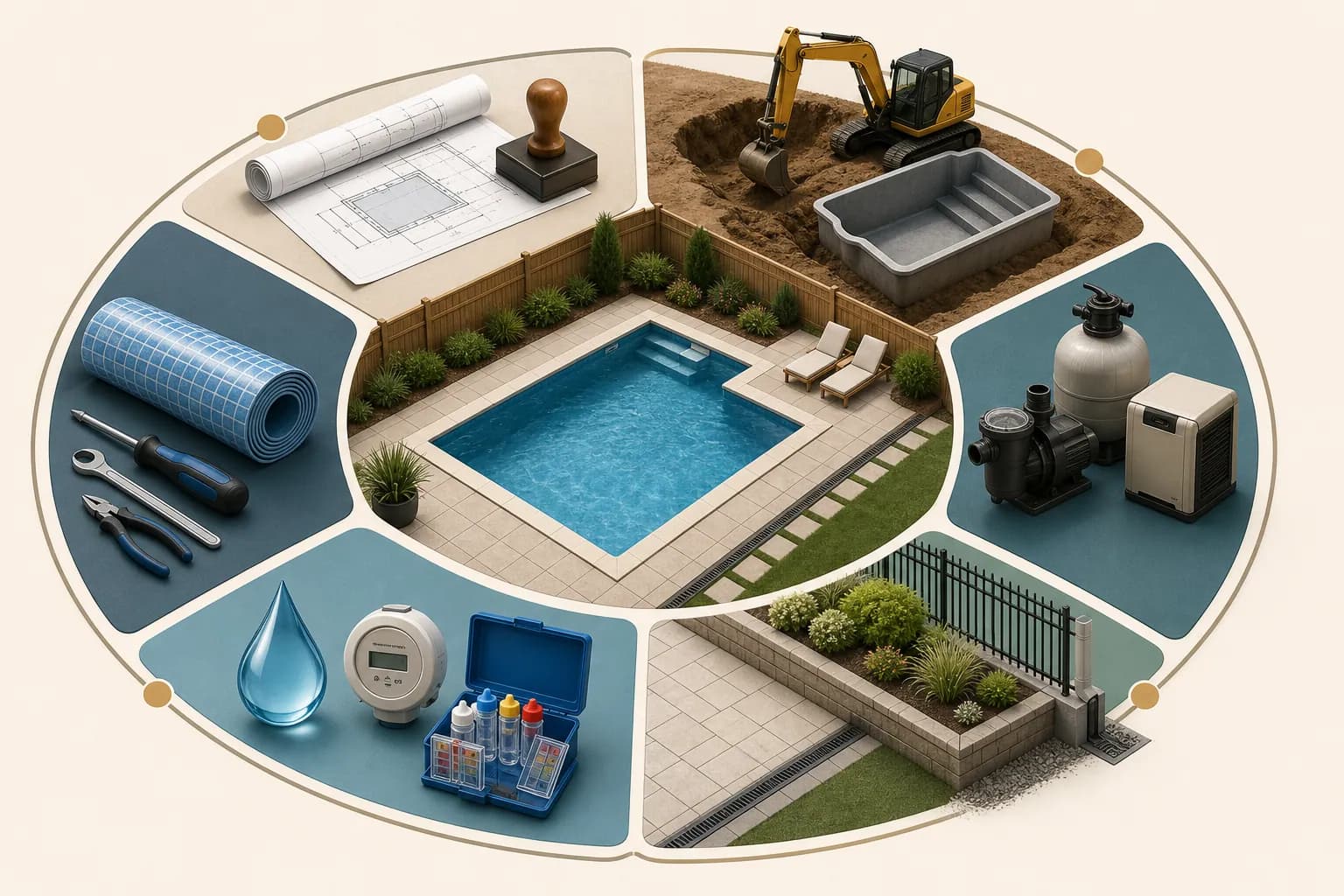
An overview of pool costs, from construction to seasonal maintenance
Besides the pool itself, allow for site work, plumbing and electrics, equipment and landscaping. Once it is built, you will also pay for electricity, water, chemicals and occasional repairs.

Work out your installation budget

A smaller above-ground pool on a properly prepared, level base is usually the least expensive starting point. Even then, the kit price may not cover everything you need: a suitable pump and filter, cover, steps, cleaning equipment, chemicals and base materials. Get local prices for the complete setup rather than comparing kit prices alone.

An in-ground pool usually involves a much larger budget because you are paying for construction as well as the pool itself. Labour rates, delivery, ground conditions, taxes and permit requirements vary between countries and regions. There is no reliable worldwide installed price. Obtain itemised local quotes for the same design and scope, including access, excavation, installation and the surrounding paving.

Size, depth, structure, finish, equipment and site conditions all affect the final price. An 8 × 4 m pool on a flat site with easy excavator and truck access will not cost the same as an equally sized pool on a slope or behind a house where soil must be carried out by hand and concrete pumped over a long distance.

A lower quote is not necessarily better value. It may cover only the shell, basic equipment and installation, while a higher quote includes excavation, pipework, electrical work, soil removal, coping and commissioning. Before comparing totals, check that the contractors are quoting for the same work.

What the advertised price may leave out

Site preparation is a common source of unexpected costs. Excavation involves more than digging a hole: soil must be removed or redistributed, the base prepared, and sometimes drainage, retaining walls or reinforcement added. Rock, groundwater or unstable fill can require changes to the original plan.

Access matters too. A fibreglass shell usually needs a crane, while a concrete pool requires material deliveries and often a concrete pump. A narrow gate, trees, overhead cables or a house between the road and the garden can complicate the work considerably. Have the contractor inspect the site before giving a final quote rather than pricing it from pool dimensions alone.

Ask what complete equipment actually includes. A quote should name the pump make and model, filter type and size, number of skimmers and returns, pipe diameters, equipment location and electrical work. Pumps and filters vary considerably in quality and capacity, so two items with the same general name can have very different prices and service lives.

The basic price may exclude paving, coping, drainage, a shower, cover, fencing and restoring the garden after construction. Some work can be scheduled later, but allow for it in the budget from the start. A pool is not ready for everyday use if you must walk through mud to reach it or rainwater collects around it.

How to compare pool quotes

Put the quotes in a single comparison table with the same rows: design and approvals, excavation, soil removal, base preparation, structure, finish, pipes and fittings, pump and filter, electrical work, heating, cover, paving, drainage and commissioning. Mark each item as included, excluded or unclear.

For work charged by quantity, ask for the unit and rate. This is particularly important for excavation, soil removal, concrete and additional building work. Ask what happens if the contractor encounters rock or groundwater. Extra work should be explained, priced and agreed before it goes ahead, not first appear on the final invoice.

For equipment, ask for exact model numbers and warranty terms. Check local service coverage and the availability of consumables and spare parts. A small purchase saving matters less if the pump fails in summer and you cannot get the part. The same applies to controls, heating, covers and specialist fittings.

Agree payments against completed, verifiable stages. Before backfilling, have pipework photographed and connections tested. At handover, obtain a valve diagram, manuals, warranties and equipment serial numbers. A service technician will need this information later; without it, a simple repair can involve searching for pipes beneath finished paving.

Allow for running and maintenance costs

Costs continue after the first fill. During the season, you pay for pumping and heating electricity, top-up water, chemicals, testing, cleaning and small replacement parts. Water volume, season length, temperature and use all make a difference. Calculate with your own utility rates and product prices rather than treating another owner's monthly bill as a forecast.

Heating and a poorly adjusted or unnecessarily long-running pump are often the main electricity costs. A heat pump can be economical, but its consumption depends on outdoor temperature, your target water temperature and overnight heat loss. Without a cover, evaporation removes both heat and water, increasing heating and refill costs.

A cover does more than keep debris out. Covered water evaporates and cools more slowly, and less dust and leaf litter enters the pool. Choose a cover you can easily put on and remove. If it is awkward to handle, it may spend the summer beside the pool instead of reducing your bills.

Budget for occasional larger repairs and replacements too. Pumps, probes, heaters, covers and finishes do not last indefinitely. A liner will eventually need replacing, grout may need repairs, and seals and valves require servicing. Set aside an annual allowance even if everything runs perfectly in the first season.

The complete budget

What you pay for when building a pool

The pool itself is only part of the bill. Include site work, plumbing, electrics, equipment and finishing the surrounding area.

Design and site assessment

Before digging, assess the site and establish whether design work, a survey or further investigations are needed. Finding a problem early usually costs less than changing the work during construction.

Excavation and access

Include excavation, soil removal, base preparation and any crane or concrete pump needed. Difficult machinery access can make the work more expensive.

The pool itself

For a composite pool you buy a finished shell; for concrete, reinforcement, concrete work and a finish; for a panel pool, the wall structure and liner. Quotes cannot be compared by dimensions alone.

Plumbing and electrics

Skimmers, returns, pipes, valves, cables and electrical protection are mostly hidden once construction is complete. Their installation still determines circulation, safety and future service access.

Pump, filter and other equipment

The quote should identify exact pump and filter models and state whether heating, lighting, automatic dosing and a cover are included. ‘Complete equipment package’ is not specific enough.

Pool surrounds

Coping, paving, drainage, barriers, steps and an outdoor shower are often excluded from the basic quote. A pool can be full of water while the surrounding space is still unfinished.

Before signing a contract

How to get a realistic quote

A quote is more reliable when the contractor has visited the site, received a clear specification and listed all exclusions.

  1. 1Write down the size you want, how many months you expect to swim and whether you want heating and a cover.
  2. 2Ask the contractor to visit the site. Photos and dimensions do not fully show access difficulties or what excavation may reveal.
  3. 3Ask every bidder to price the same scope. List soil removal, electrical work, paving, drainage and commissioning explicitly.
  4. 4Identify fixed-price items and those that will be charged according to the actual quantity of work.
  5. 5Agree that additional work requires an explanation and your approval before it proceeds.
  6. 6Before signing, estimate seasonal electricity, water, chemicals and routine maintenance using your own local prices.
Illustration of pool costs from design and construction to operation and refurbishment
The total includes initial construction, equipment, landscaping, seasonal bills and later repairs.

Why prices vary

Why pools of the same size can cost different amounts

Length and width are only part of the calculation. Ground conditions, access, construction method, equipment and the surrounding finishes all affect the price.

Size and shape

More water volume generally means more excavation, structure, finishing and fill water. Complex shapes and details can increase the price faster than size alone.

Ground conditions and groundwater

Rock, made ground, clay, slopes or groundwater may require extra excavation, drainage, retaining structures or a different foundation design.

Site access

A narrow gate, long approach, overhead cables, neighbouring boundaries or limited working space may require smaller machinery and more manual labour.

Finishes and extras

Simple paving and standard coping cost less than natural stone, overflow edges, elaborate steps, a built-in cover or additional lighting.

Comparing quotes

Check what each quote actually includes

Put both quotes into the same table. You can then see whether one is genuinely cheaper or simply leaves out part of the work.

Fixed price with a clear specification

The item has a specified model or quantity, a price and a clear description of what is included. These are the easiest items to compare.

Price based on actual quantities

Excavation, soil removal, backfill and some labour are often charged by volume, load or hour. Ask for the unit rate as well as the estimate.

Possible additional work

Rock, groundwater or buried services may require extra work. Agree in advance who prices it and who authorises it.

Paid separately

Work you arrange with another contractor or pay for later, such as electrics, barriers, paving, drainage or landscaping.

Set aside money for unexpected costs

Construction can reveal work that could not be predicted beforehand, particularly after excavation. Keep part of the budget available for this. Before approving extra work, ask the contractor to explain what is needed and how much it will cost.

After construction

What will a swimming season cost?

Heating, pump hours, top-up water and maintenance are usually the main variables. Use your own tariffs and supplier prices; someone else’s bill is only a rough reference.

Electricity

Energy use depends on equipment input power and operating time. A correctly sized pump and suitable schedule often save more than buying a larger unit.

Water

Allow for evaporation, splashing, filter cleaning and seasonal procedures. Leaks can add to the bill. Using a cover and identifying leaks early reduces unnecessary top-ups.

Chemicals and testing

Warm water, heavy use and strong sunlight increase chlorine demand. Regular testing usually costs less than adding products at random and later treating green or cloudy water.

Consumables and servicing

Test reagents, cartridges, seals, probes, lamps and service visits will not cost the same every year. Include them when estimating average annual running costs.

Lower running costs

Where you can make worthwhile savings

Use the cover regularly, set the pump correctly and investigate unusual water loss promptly. These are practical ways to avoid unnecessary running costs.

  1. 1Plan the cover from the outset, including space for a reel or mechanism. Regular use reduces evaporation and heat loss.
  2. 2Choose a pump for the pool and its pipework. Lower speeds can substantially reduce power consumption, but flow must still meet the needs of every connected device.
  3. 3Avoid heating more than you need. Higher water temperatures mean greater heat loss and higher heating costs.
  4. 4Clean the filter according to pressure readings and the manufacturer’s instructions. Backwashing too often wastes water; neglecting the filter reduces flow.
  5. 5Watch the water level and investigate unusually frequent top-ups. An automatic filler can conceal a leak for a long time.
  6. 6Keep a record of the original settings and monitor consumption. This lets you see whether a change actually saves money.

Long-term ownership

Allow for repairs a few years from now

Keep records of installed equipment and expect the liner, cover or parts of the system to need repair or replacement eventually.

Every year

Allow for opening and closing the pool, testing, chemicals, cleaning, water, electricity and small consumable parts.

Occasional servicing

Seals, valves, probes, lights and pump parts do not need replacing every season, but some will need servicing or replacement over the years.

Major replacements

Liners, coatings, grout, paving, covers and equipment eventually need refurbishment or replacement. Timing depends on the materials, water quality, climate and maintenance.

Keep equipment and pipe connections accessible

An accessible valve or joint is easier to inspect and replace. Photos taken before burying pipes can save time and unnecessary demolition later.

Practical answers

Pool cost and budget questions answered

How much does a pool cost?

There is no reliable worldwide price for a pool. Local labour rates, ground conditions, construction type, equipment and the scope of the quote make a substantial difference. Ask local installers to quote for the same design and list of work. For running costs, enter your own electricity, water, chemical and service prices in the calculator rather than converting figures from another country.

How much should I set aside for unexpected work?

No percentage suits every project. Allow more when ground conditions, groundwater, buried services or access have not been fully investigated. A contingency does not replace proper design, a detailed quote and a clear contract.

Is an above-ground pool always cheaper?

It is usually cheaper to buy, but the base, electrics, equipment, cover and surrounding area still cost money. Compare options with similar equipment and suitability for the way you plan to use them.

Which costs do owners most often overlook?

Surrounding works, safety barriers, covers, electrics, drainage and reinstating the garden are often underestimated. After construction, heating and eventual major replacements are easy to overlook.

Does more expensive equipment always reduce running costs?

No. Savings depend on correct sizing, operating hours, tariffs, climate and maintenance. Ask for performance data and calculate savings for your circumstances, not the best-case example in an advert.

How do I compare quotes in different formats?

Put both into the same categories: design, site preparation, structure, plumbing and electrics, equipment models, finishing, safety, documentation and exclusions. Mark any gaps and ask for written clarification.

Does a cover really affect the budget?

Yes. Less evaporation means less top-up water and heat loss, and often less cleaning and chemical demand. The benefit depends on the cover type and how consistently you use it.

How should I budget for future refurbishment?

Keep material and equipment details, warranty terms and service records. Setting some money aside each year helps cover eventual liner, cover or equipment replacements, even though these are not annual expenses.

Before you decide

Check size, construction type and purchase terms