Cloudy water after rain
Rain and runoff can introduce dust, soil and organic matter. Substantial added water can also change chemistry. Test, remove larger debris and check filtration before adding products.
Water problem
Do not start by pouring in more chemicals. Keep swimmers out if the floor is not clearly visible, until the water clears and tests are satisfactory. Measure pH and free chlorine, check circulation and the filter, and consider clarifier or flocculant only after identifying the cause.
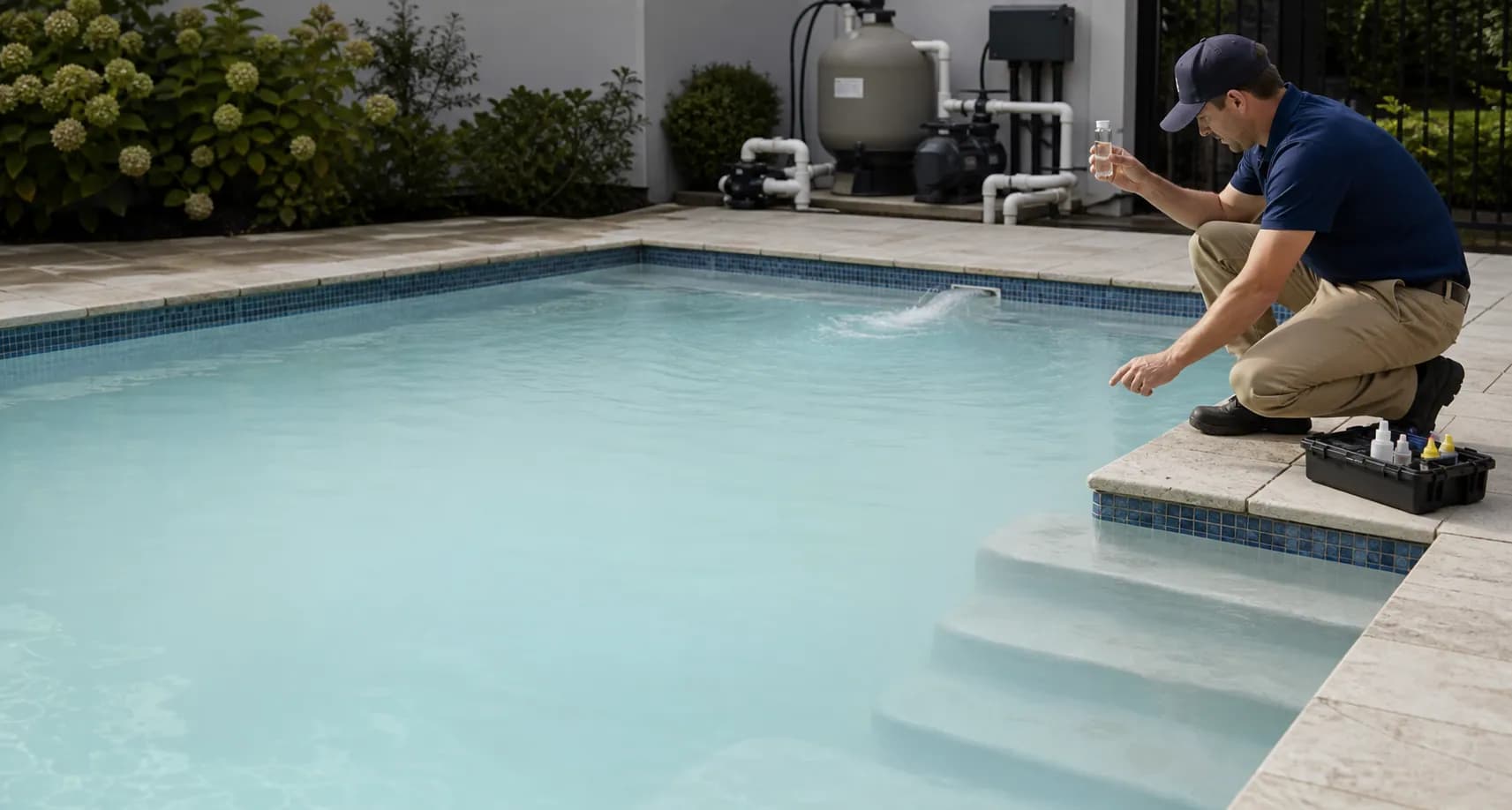
What to check first
Water appearance
Rain and runoff can introduce dust, soil and organic matter. Substantial added water can also change chemistry. Test, remove larger debris and check filtration before adding products.
Do not automatically add more chlorine. Check pH and other readings. Fine particles or mineral precipitation, rather than low chlorine, may be responsible.
Investigate algae growth carefully.
Learn moreWell water or other fill water containing dissolved metals can change colour when iron or other metals oxidise. This differs from green water caused by algae.
To clear cloudy pool water, start by checking pH and free chlorine, then circulation and the filter. Resist the urge to add more products straight away. If too little water is passing through the system, or the filter is not removing fine particles, extra chemicals will not fix the cause.
Written and edited by: Pool Explained editorial team

Measure pH and free chlorine with a reliable test kit. Take the sample away from a return jet and read the result as instructed. If you use stabilised chlorine, check cyanuric acid too: it affects how much chlorine you need.
Adjust one reading at a time, using the actual pool volume and the product label. Run the circulation for the specified time, then test again. This lets you see whether the adjustment worked, without adding several products whose effects become difficult to separate.
If you cannot clearly see the pool floor, stay out of the water until visibility is restored and test results are back within the acceptable ranges.
Check the water level, skimmer basket, pump basket, valve positions and the strength of the return jets. Weak flow, air under the pump's clear lid or a skimmer drawing in air can indicate that too little water is reaching the filter.
If the filter has a pressure gauge, compare its reading with the pressure recorded when the filter was clean. Backwash a sand filter or clean a cartridge only as the manufacturer instructs. If dirt is coming back through the jets, check the filter media, internal components and multiport valve.
For an approximate turnover time, divide the pool volume by the actual flow rate. This does not guarantee that every drop has passed through the filter, but it is a better starting point than running every pool pump for the same number of hours.
A clarifier binds very fine particles together so the filter can trap them. A flocculant forms larger clumps that settle and are usually vacuumed to waste. These products are not interchangeable, and neither is suitable for every type of filter.
Before use, check the label for filter compatibility and instructions for removing the settled material. If your system cannot vacuum to waste, a flocculant may create more work than it saves.
Once the water is clear again, test pH and free chlorine and clean the filter if needed. If the cloudiness soon returns, check flow, filtration and the source of the dirt again rather than repeating the same treatment.
What not to do
Check the water and system first. Adding products at random usually prolongs the problem.
Next steps
Understand pH, free chlorine and related readings.
Learn moreIf circulation seems normal but particles return, check filtration.
Learn moreIf returns are weak or the pump struggles to draw water, address flow first.
Learn moreEstimate required flow from pool volume.
Learn moreIt does not automatically mean more chlorine is needed. Check pH, free chlorine and filtration. In mineral-rich water, a change in chemistry can cause minerals to precipitate.
No. Check chemistry, flow and filtration first. Flocculant is appropriate only when very fine particles are the problem and the system allows the resulting sediment to be removed correctly.
There is no fixed number for every pool. Divide volume by approximate actual filter flow to find one theoretical turnover time. Monitor improvement over one or two such periods rather than assigning the same hours to every system. Do not treat that time alone as permission to swim.
When the floor is clearly visible, the water is no longer cloudy, readings are in the recommended range and the treatment product’s waiting period has passed.
Often because the symptom was treated but the cause remains. Check particle capture, flow, pump hours and continuing contamination.
No. Fine particles, unsuitable chemistry, poor flow, filter problems or organic contamination can cause it. A green tint or slippery deposits make algae more likely.