How often should you test pool water?
It depends on temperature, sanitizer system and pool use. Test more often during hot weather, after rain or heavy use, and always before a substantial adjustment.
Maintenance throughout the season
Check water clarity, flow and the filter regularly. Test before making chemical adjustments, and adapt maintenance to the weather and pool use. The guides below explain each job in detail.
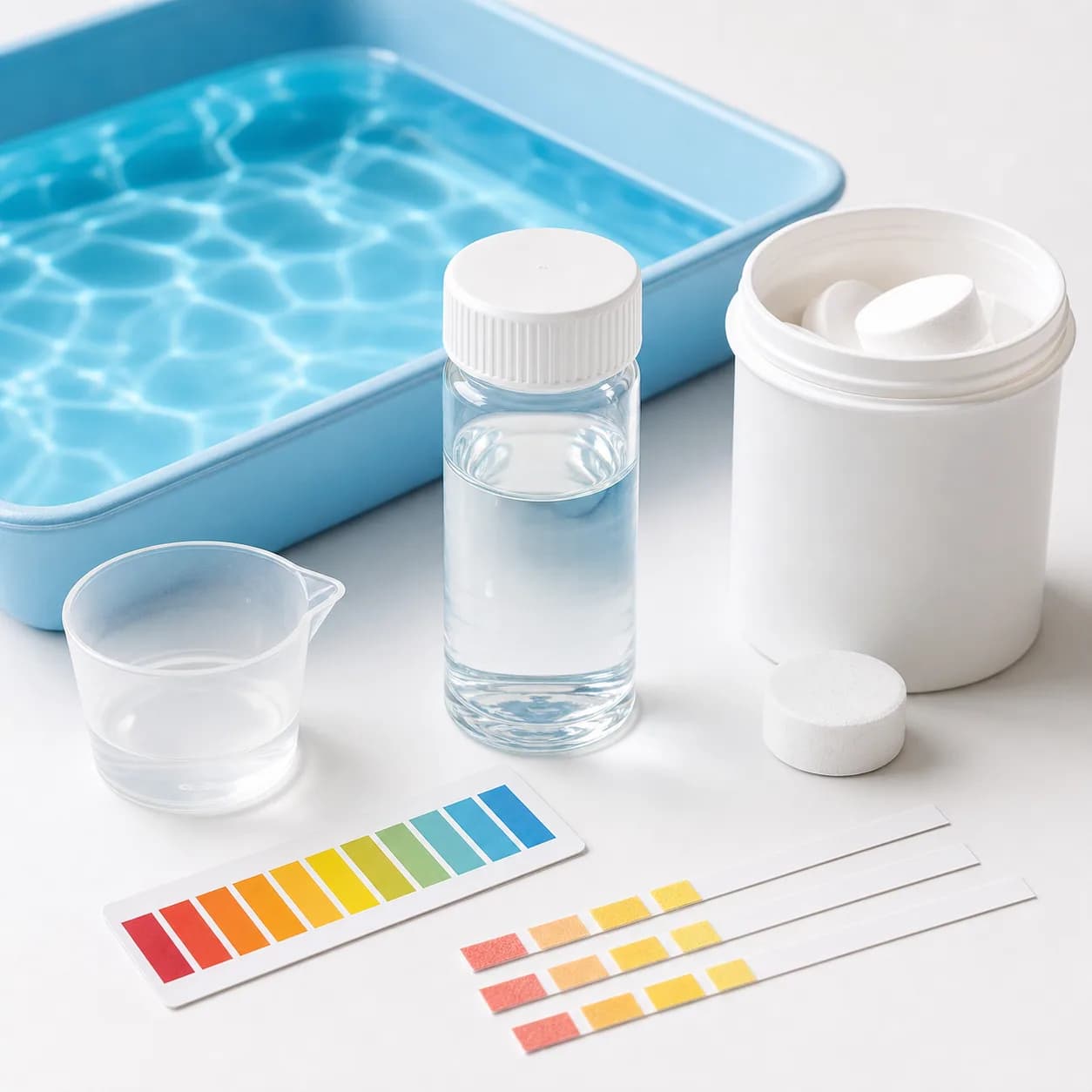
Regular maintenance
Follow the same basic routine, but adjust how often you do it for the temperature, weather and number of swimmers.
Start here
Understand how pH, sanitizer, alkalinity, stabilizer, circulation and filtration work together.
Learn more Calculating a doseUse the test result, water volume and product strength to calculate a dose. There is no one-size-fits-all scoop.
Learn more Daily and weekly maintenanceWhat to check in hot weather, after rain and when lots of people use the pool.
Learn more When something goes wrongFind help for cloudy or green water, weak flow, foam, unusual smells or water loss.
Learn moreWater chemistry in practice
When it is needed, how to calculate a dose and what to check before swimming again.
Learn more Getting your pool readyWhat to inspect, test and adjust when filling a pool with fresh water.
Learn more Choosing a productCheck the active ingredient, concentration, stabilizer and application method, not just whether the product comes as tablets or granules.
Learn more Adjusting water chemistryConfirm the reading, check alkalinity and lower pH in controlled stages.
Learn more Swimming safelyFollow the label's waiting time, then retest and check the water is clear before swimming.
Learn moreSeasonal guides
Inspect the pool, reassemble the equipment and start filtration before treating the water.
Learn more Swimming seasonAdjust testing, cleaning and pump runtime for temperature, rain and pool use.
Learn more AutumnClean the pool and prepare the pipes, pump, filter, heater and cover for winter.
Learn moreTroubleshooting
Check pH, free chlorine, flow and the filter before adding clarifier or flocculant.
Learn moreWork out whether algae or metals are causing the colour, then choose the appropriate treatment.
Learn moreStart with the water level and baskets, then check the filter, valves and pump.
Learn moreCompare water loss with evaporation before looking for a leak.
Learn moreCalculators
You need the actual water volume to calculate chemical doses and estimate filtration time.
Learn moreEstimate the amount needed using the water volume and product label.
Learn moreCalculate one theoretical turnover from water volume and actual flow.
Learn moreIt depends on temperature, sanitizer system and pool use. Test more often during hot weather, after rain or heavy use, and always before a substantial adjustment.
No. Clarity matters, but it does not tell you the pH or sanitizer level. You still need to test.
Check whether you can see the bottom, test the water and inspect flow and filtration. Then decide whether an additional treatment is needed.
Not necessarily. Use volume and actual flow to estimate a starting schedule, then account for temperature, swimmers, clarity, filter condition and equipment requirements.