High pH reduces chlorine's effectiveness, encourages scale and can contribute to cloudy water. Do not guess the dose or try to correct it with one large addition. First confirm the reading with a reliable test, check alkalinity and pool volume, then use a pool pH reducer according to its label, with circulation running and no swimmers in the water.
Written and edited by: Pool Explained editorial team
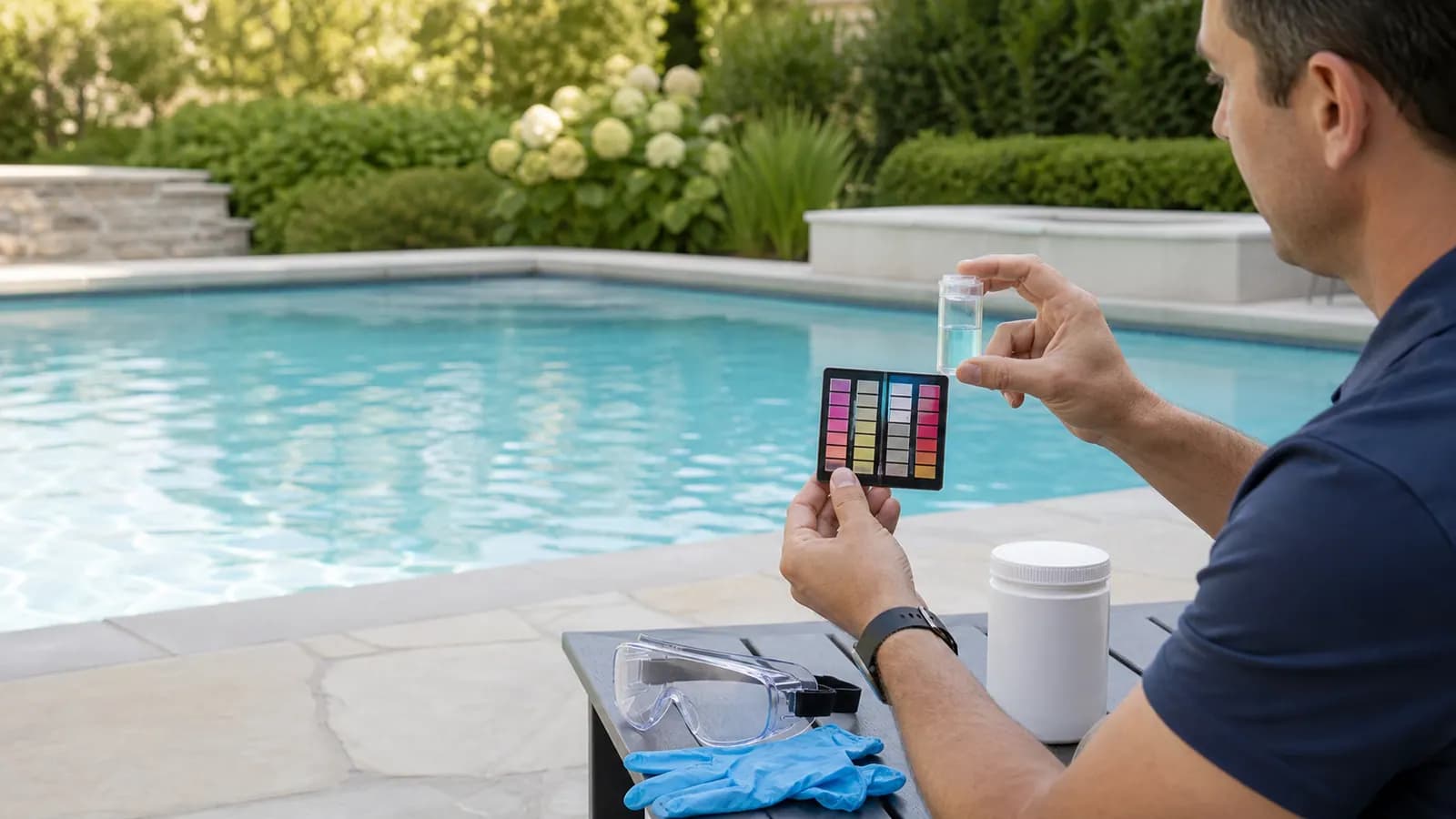
Check the pH reading first
Retest with fresh reagent, taking the sample away from return jets, the skimmer and any place where chemicals were recently added. Use and read test strips exactly as instructed. A suitable liquid-reagent test kit or a reliable photometer will generally provide more precise results. The CDC gives a general pH range of 7.0–7.8; above 8.0, chlorine becomes less effective at killing microorganisms.
Cloudy water or white marks on a wall do not prove that pH is high. Hardness, high alkalinity, filtration problems or several factors together can cause similar symptoms. Test total alkalinity too: it indicates how strongly the water resists a change in pH. High alkalinity often means you will need more acid overall, added through several measured adjustments.
Record when you took the sample and what you added in the previous few hours. Readings just after adding alkalinity increaser, refilling or vigorous aeration may differ from later readings. New cement-based finishes can cause pH to rise repeatedly during start-up. Follow the installer's care instructions rather than trying to prevent every future rise with one large dose.
If a result is unexpected, check the reagent expiry date and make sure the sample container is clean. Very high chlorine can interfere with some tests. If two tests differ substantially, have the sample checked with a reliable kit, by a laboratory or by a pool specialist who maintains their testing equipment properly before adding chemicals.
Choose a pool pH reducer and calculate the dose
Pool pH reducers are acid-based, commonly solid sodium bisulphate or hydrochloric acid at a specified concentration. They are not interchangeable by weight or volume. The product concentration, pool volume, starting pH and alkalinity determine how much you need. Use the dosing table or calculator supplied by that product's manufacturer.
Start with the actual volume of water. Do not dose a 30 m³ pool as though it held 40 m³ just because the outside dimensions look similar. Steps, benches and the current water level affect volume. If you are unsure, use a conservative initial dose within the label instructions, circulate and retest before adding more.
Alkalinity explains why the same dose does not produce the same pH change in two pools. Water with higher alkalinity resists the change more strongly. A rule such as one cup per 10 m³ is therefore unreliable and potentially dangerous. Use dry measuring equipment dedicated to the product, kept clearly separate from chlorine equipment.
Do not use household acids, cleaning products or chemicals of unknown composition. A pool product has a stated concentration, instructions and a safety data sheet. If an automatic system doses acid, check its probe, calibration, non-return valves and no-flow dosing interlock. A faulty probe can cause prolonged overdosing and dangerously low pH.
Add the product safely, in measured stages
Keep everyone out of the pool during treatment. Wear the protection specified on the label, open containers in a well-ventilated place and avoid breathing dust or fumes. Never open or measure chlorine and acid together. Mixing them can release toxic gas even though both products are intended for pool use.
Add the product exactly as the label describes. Pre-dissolve solids only where instructed; some liquids must be poured slowly at a specified location with circulation running. If pre-dissolving is permitted, add the product to water, never water to concentrated chemical. Do not use a container that previously held chlorine or another pool chemical.
If a large adjustment is needed, divide it into smaller doses within the label limits. After the first dose, run the pump for the specified time and take a new sample away from the addition point. This reduces the risk of overshooting and exposing metal parts, plaster, grout or the heater to excessively acidic water.
Do not pour acid into the skimmer unless the chemical and all relevant equipment manufacturers explicitly permit it. Concentrated acidic water can pass through the pump, filter and heater before diluting in the pool. Do not leave undissolved granules on a liner or steps. If you spill a product, keep people away and follow its safety data sheet; do not try to neutralise it with another pool chemical.
Find out why pH keeps rising
After the circulation time stated on the product, retest pH and free chlorine. Swimming can resume only once the readings are within the required ranges and the label's waiting time has passed. If pH is still high, check that the previous dose has fully dispersed and that your volume estimate is correct before adding more.
High alkalinity, strong aeration, overflows, waterfalls, upward-facing return jets and salt chlorinators can all contribute to rising pH. A new cement-based finish can affect pH during curing too. Do not try to prevent all future changes with one large acid dose. Follow the readings and make gradual adjustments.
If pH drops sharply after a dose and then quickly rises again, check both your testing method and alkalinity. A log of dates, pH, alkalinity, doses and pump running times tells you more than a single test. Change one thing at a time and test at a similar time of day so you can compare the results.
If you need unusually large quantities of acid, pH is not responding as expected, or corrosion, stains or scale appear, stop dosing by trial and error. A reliable water analysis and equipment check may reveal an inaccurate test, very high alkalinity, hardness problems or a dosing system fault. Finding the cause costs less than repeating a large correction every week.