There is no single waiting time that makes swimming safe. Wait at least as long as the product label specifies, keep circulation running and retest free chlorine and pH. Swim only when the readings are within the required ranges, the water is clear and you can clearly see the bottom.
Written and edited by: Pool Explained editorial team
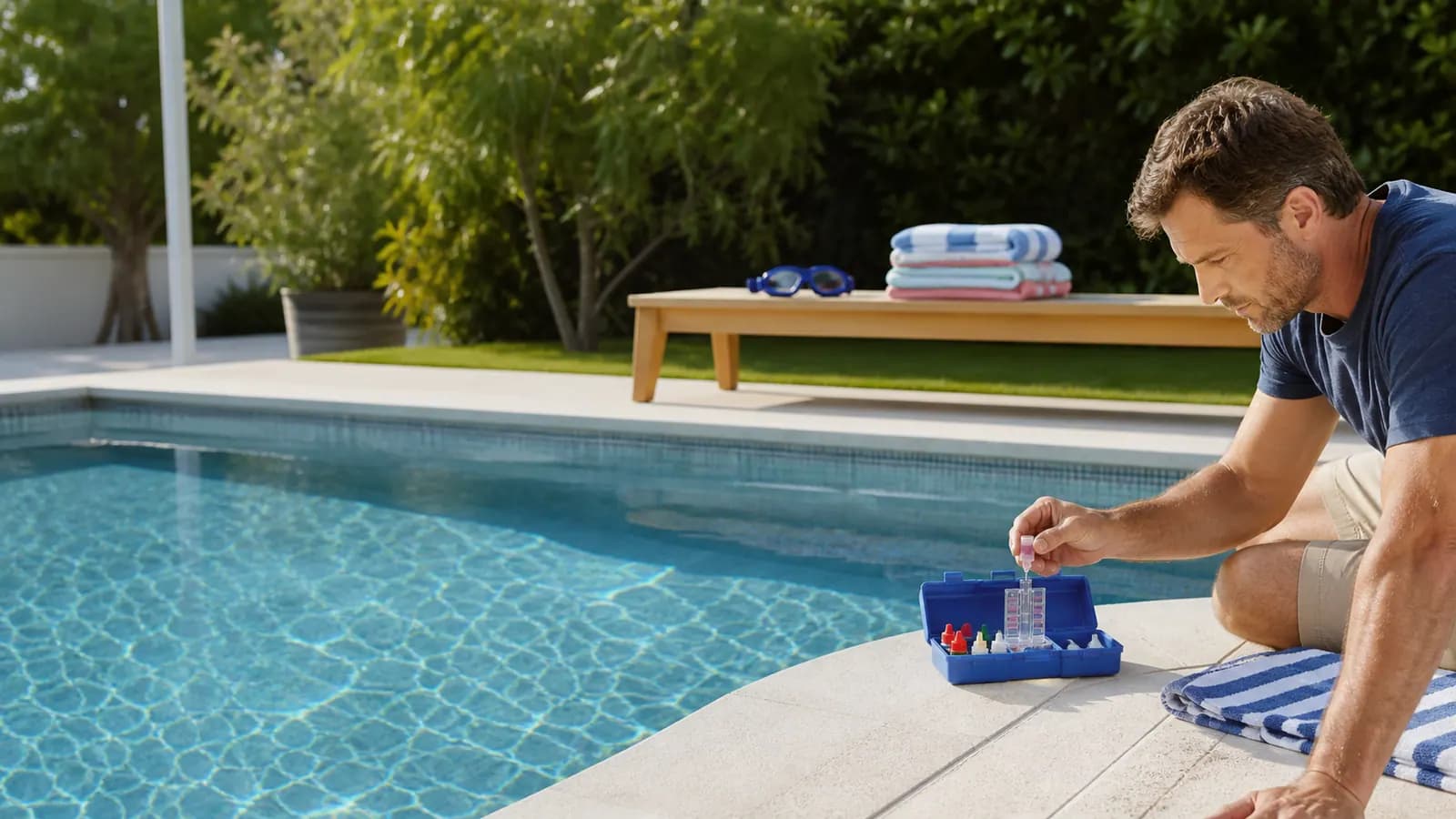
Read the label, then test the water
Products differ in concentration and application. A small routine dose of liquid chlorine, a slow-dissolving tablet and a large shock treatment cannot all have the same waiting time. Check the label for re-entry instructions and the required free chlorine level. If the label is unreadable or you do not know what was added, keep the pool closed until you have reliable instructions and a valid test result.
For home pools, the CDC gives a typical chlorine range of 1–4 ppm and a pH range of 7.0–7.8. When cyanuric acid or stabilised chlorine is used, the recommended minimum free chlorine is 2 ppm. These are general health guidelines, not a replacement for the maximum level and waiting time on your product label.
Take samples away from return jets, floating dispensers and chemical addition points. Allow enough circulation to mix the whole pool. A sample beside a return jet can read much higher than the rest of the pool, while one from a poorly circulated corner can read too low. After a major treatment, test several locations if circulation is uneven.
If a test reads zero after you added a large amount of chlorine, do not assume all the chlorine has been used up. Very high concentrations can bleach some tests and produce a falsely low reading. Retest using the test manufacturer's procedure or a suitable higher-range kit. Do not add another dose on the strength of a questionable result.
A routine dose and a shock treatment need different checks
Routine dosing aims to keep chlorine within its operating range. After a small adjustment made according to the label, swimming may be possible the same day if circulation has dispersed the product and a new test confirms an acceptable level. But products are not interchangeable: some specify a circulation period or a swimming exclusion after direct addition.
Shock chlorination deliberately raises chlorine above its normal operating level. The wait is often longer and depends on the dose, sunlight, stabiliser, temperature and the amount of contamination to oxidise. An evening treatment does not automatically make swimming safe the next morning. Test again.
After treating algae, waiting for chlorine to fall is not enough. The water must be clear, the bottom visible and the walls clean, with dead algae removed by filtration and vacuuming. Cloudy water can hide a swimmer who needs help and means the clean-up is not finished. Keep the pool closed until visibility is restored.
Do not assume a strong smell or irritation means there is too much free chlorine. Chloramines, formed when chlorine reacts with sweat and other contamination, often cause the smell. Measure free and total chlorine, calculate combined chlorine if your kit supports it, and treat the problem identified by the results.
Four more checks before swimming
First, check pH. Chlorine performance depends partly on pH, and a reading that is too high or too low can compromise treatment, cause discomfort and damage equipment. An acceptable free chlorine reading is not enough when pH is outside the required range. If you also added acid or pH increaser, observe that product's waiting time too.
Second, look along the length of the pool: the floor, drains and steps should all be clearly visible. Third, check that the pump and filter are working normally and no undissolved granules remain on the floor. Fourth, remove or secure the dispenser as the system instructions require, especially if children could open it or play with it.
Do not judge water safety by smell, taste or touch. Clear water can contain too much chlorine, while a pool without a strong smell can have too little disinfectant. A reliable test and the product label provide information your senses cannot. Test strips are convenient, but a suitable DPD kit gives more precise chlorine readings after a large adjustment.
Do not use a child, someone with sensitive skin or someone with a respiratory condition as the first test of whether the water is suitable. If a swimmer has reacted before, wait for stable readings and seek medical advice where needed. In an indoor pool, check ventilation too, as chloramines can accumulate in the air above the water.
What to do if chlorine is outside the required range
If free chlorine is too high, close the pool and continue circulation as instructed. Sunlight can help break down chlorine outdoors, but the rate depends on stabiliser and weather. Do not add acid, another chlorine type or an unfamiliar chemical to alter the reading. Randomly mixing products is not a safe way to neutralise them.
Chlorine reducers are available, but they require an accurate calculation and strict adherence to the label. Too much can remove all free chlorine and leave the water without disinfectant. For a home pool, allowing time for chlorine to fall while circulating and retesting is often safer than adding another chemical. If the level is very high or the pool needs to reopen quickly, contact a pool professional.
If chlorine is too low, do not let people swim on the promise that you will add it later. Swimmers introduce more organic matter and increase chlorine demand. Correct the level using the pool volume and product instructions, wait the required time and test again. When using stabilised products, monitor cyanuric acid too, as it affects the required chlorine minimum and speed of disinfection.
Record when you dosed, the product and quantity, and the readings before dosing and before swimming. Over time, you will learn how your pool usually responds to a small adjustment or a larger treatment. That experience is useful, but it never replaces a fresh test when weather, swimmer numbers, temperature or products change.