
For occasional summer swimming, a good-quality above-ground pool on a properly prepared base is often the simplest option. For a permanent pool, compare fibreglass, panel and concrete construction against your site conditions, installation time, preferred shape and total budget. Do not choose by photograph or material name alone: the pool must suit how you will use it and be suitable for installation in the space you have.
Written and edited by: Pool Explained editorial team
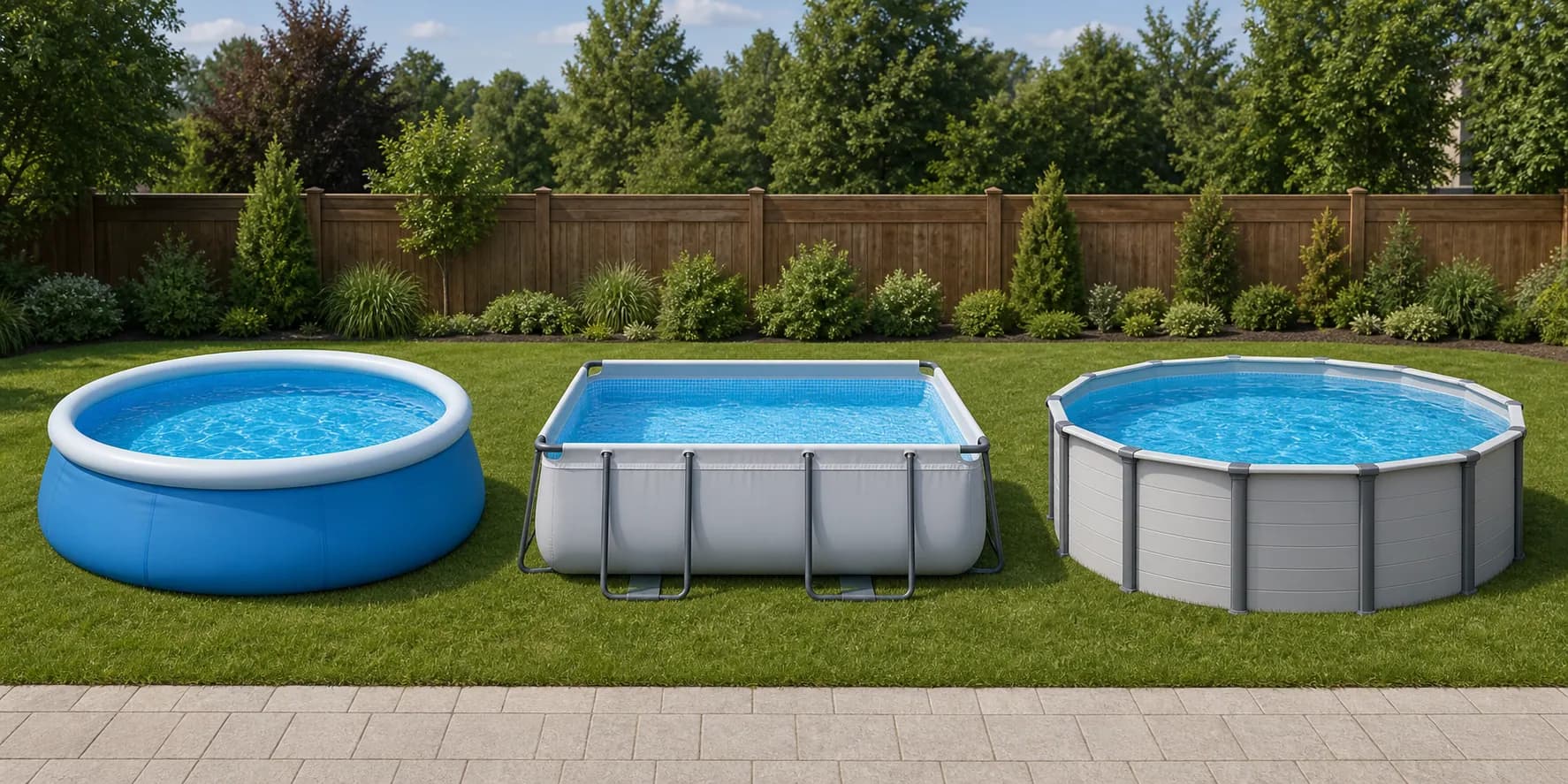
First decide whether you want a seasonal or permanent pool
An above-ground pool makes sense if you want summer swimming without major building work and are willing to pack away or protect parts of the system at the end of the season. The initial cost is lower, installation is quicker and it is easier to change your mind later. You still need a level, stable base, filtration suited to the volume and protection against unsupervised access.
With a permanent pool, you are buying more than a shell. It becomes part of the property and affects drainage, services, access around the garden and the appearance of the space throughout the year. Plan for excavation or structural work, the base, pipework, electrics, equipment space, decking and safe access.
If you are unsure how much you will use a pool, a season with a good above-ground model may teach you more than ten catalogues. You will find out how much time you spend in the water, how you feel about cleaning, whether you want heating and which part of the garden works best. That is not a compulsory trial for everyone; it simply means you need not commit to permanent construction before your needs are clear.
How fibreglass, panel and concrete pools differ
A fibreglass pool arrives as a finished shell. Installation is usually quicker than building a pool on site, and the interior surface is factory-finished. The main limitations are the available shapes and sizes and access to the property: the shell must reach the excavation from the road. Proper bedding, groundwater control and backfilling matter just as much as the quality of the shell.
A panel pool is assembled from structural sections and usually finished with a liner or reinforced PVC membrane. The parts are easier to bring through narrow access, and there may be more flexibility in size and shape than with a one-piece shell. However, the base, bracing, joints, fittings and backfill must be installed accurately. Budget for replacing the membrane after its service life too.
Concrete gives you the most freedom over shape, varying depths, steps and fitting a pool into a complex site. It requires more design work, skilled trades and inspections along the way. The reinforcement, concrete, waterproofing and final finish must be compatible. Construction takes longer, and mistakes made early can be expensive to correct later.
None of these three systems is automatically the best. Fibreglass can be an excellent choice if a suitable model can reach the site. Panels can be practical where access is narrow or you want dimensions unavailable as a ready-made shell. Concrete makes sense when a custom shape and integration with the property matter more than speed of construction.
Pool linings and circulation systems are not construction types
A liner or reinforced PVC membrane describes the watertight surface, not necessarily the structure beneath it. A membrane may be installed over a panel or concrete pool. Ask not only whether you want a liner, but what supports it, how corners and fittings are detailed, and who warrants the underlying surface and welded joints.
Skimmer and overflow pools differ in how surface water reaches the filtration system. An overflow design can provide a waterline level with the surrounding edge and effective collection of surface debris, but requires a channel, balance tank and more equipment space. Skimmer systems are simpler and common in private pools. Either can be used with different structural types.
The term saltwater does not identify a construction type either. It usually means a device produces chlorine from dissolved salt. You still need to test the water, adjust pH and maintain the equipment. A natural swimming pool is different: it relies on a biological system and usually needs a separate regeneration area or specially designed filtration.
A spa or hot tub contains less water at a higher temperature and has a much greater bather load per litre when several people use it. Water treatment, ventilation and maintenance therefore differ from those of a conventional garden pool. A smaller size does not necessarily mean less work.
Compare quotations for the same scope of work
The catalogue price of a pool is rarely the cost of a finished swimming area. Ask for transport, excavation, spoil removal, the base, drainage, assembly, pipework, electrics, filtration, commissioning, decking and protection against unsupervised access to be listed separately. Only then can you meaningfully compare two quotations.
Find out what happens after installation. Ask how much access filter servicing requires, which consumable parts need replacement, what the warranty covers and who visits if a fault occurs. Cheap equipment without available spares, or equipment you cannot reach, can become expensive at the first breakdown.
You should be able to explain your choice simply: it suits the way you will use the pool, can be installed properly on your property and fits both your construction and maintenance budgets. If your reasons come down to a discount, a photograph or a claim that one material is best, take another look before committing.