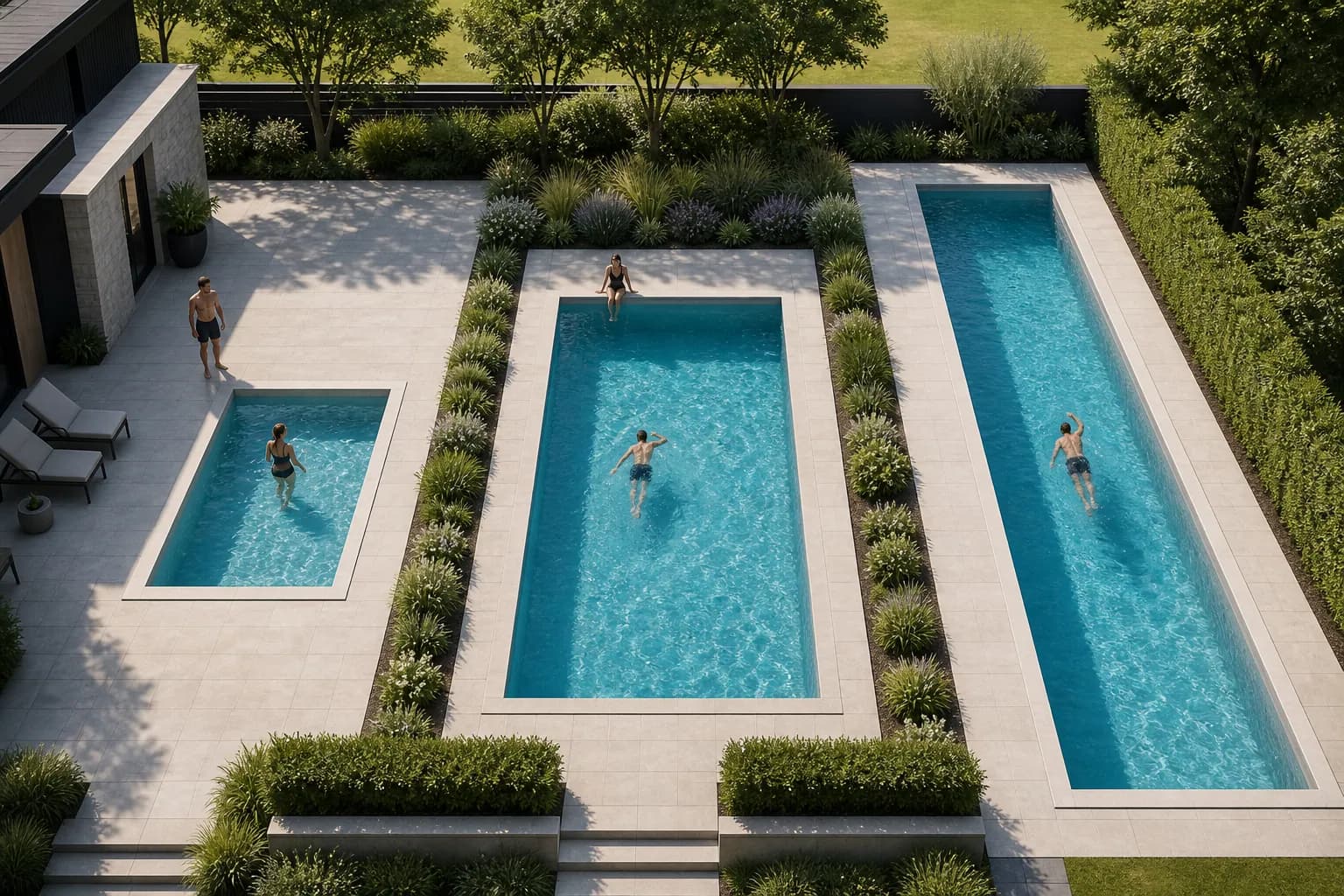
For family play and cooling off, a pool 6–8 metres long and 3–4 metres wide is often enough. For regular swimming, an unobstructed straight length matters more, so consider a longer, narrower pool or a counter-current system. Water dimensions are only the start: the site must also accommodate the structure, deck, equipment, cover and safe walkways.
Written and edited by: Pool Explained editorial team
Choose dimensions to suit how you will use the water
A pool used mainly by two people relaxing need not be the same size as one where several children play together. Write down your usual use, then the occasional maximum. The number of people alone is not enough: four people sitting and talking use the space differently from two people trying to swim in opposite directions.
For swimming lengths, you need a clear route without steps, benches or a shallow shelf in the way. An eight-metre pool will not give you eight metres to swim if wide steps occupy two of them. A counter-current unit can help in a short garden, but try it or check its flow, position and operation carefully before buying.
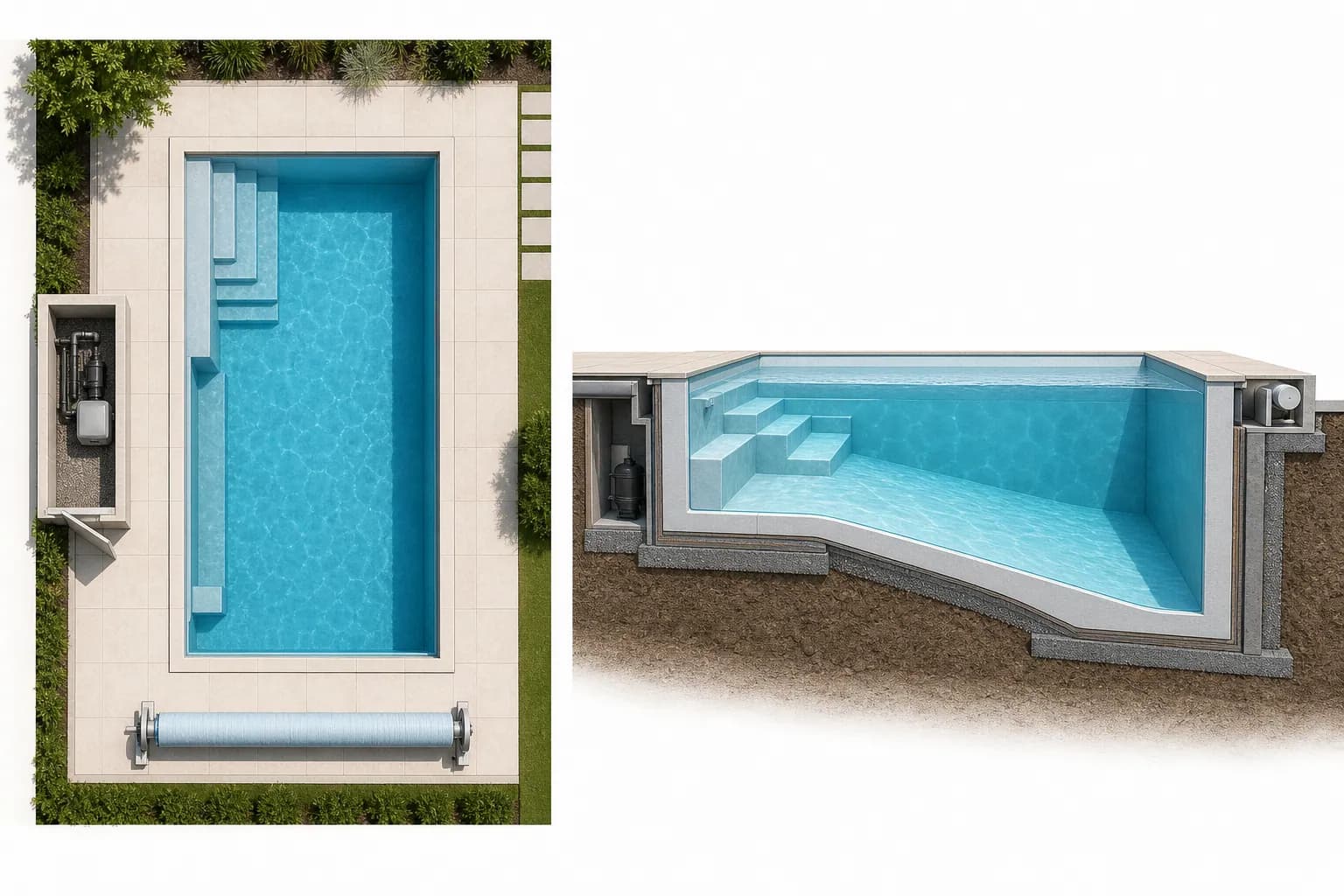
For play, width and clear space often matter more than an extra metre of length. A bench or wide step is useful for sitting and relaxing, but draw these features to scale. Ask for the internal water dimensions after all built-in features are included, not just the outside dimensions of the structure.
A simple check is to mark the proposed pool out with string on the ground. Add the steps, deck, loungers and route to the house. Walk through the space as if the pool were already there. You will quickly see whether the water area is too large for the garden or leaves too little room around it for everyday use.
Allow for more than the water area
If a quotation says 8 × 4 metres, ask whether that means the internal water dimensions, outside shell dimensions or simply the model's nominal size. Walls, reinforcement and structural details increase the footprint. The excavation is usually wider still, because installers need room for assembly, pipework, drainage and backfilling.
Once construction is complete, you need a deck wide enough for safe walking, access to the water and opening the cover. Equipment needs servicing space, and a fence and gate should not be squeezed between the pool and the property boundary. Required clearances depend on the design and local rules; do not copy them from somebody else's online sketch.
For example, an 8 × 4 metre water area covers 32 square metres. Add a walkway and deck roughly two metres wide around it and the rectangular area becomes approximately 12 × 8 metres, or 96 square metres. This is not a universal deck specification, but an illustration of how the whole project can occupy much more space than the water alone.
Check construction access too. A one-piece fibreglass shell must be brought to the excavation, whereas panels arrive in smaller sections. Allow room for an excavator, lorry or concrete pump. A garden can have enough space for the completed pool but not for the vehicles and equipment needed to install it.
Choose a depth for your household, not by copying a public pool
A private family pool is often used for standing, playing and relaxing. A consistent, moderate depth can be more practical than an abrupt change from shallow to deep water. The choice depends on users' heights, planned activities and the pool system. Young children and non-swimmers need direct supervision at any depth.
If you want different depths, check how much usable length remains in each area. A short shallow section and steep slope may look attractive in a cross-section but be uncomfortable for both standing and swimming. Changes in depth should be clear and constructed in accordance with the system's requirements.
A deep end alone does not make diving or a diving board safe. These activities require a correctly designed entry zone, not just one acceptable depth measurement. Follow the design, manufacturer documentation and applicable rules rather than deciding that the pool looks deep enough.
Steps, benches and shallow shelves can make a pool much more usable, particularly for older people and anyone who likes sitting in the water. Their area is not wasted if your household actually uses them. The problem is adding catalogue features without checking how much clear space will remain.
How pool size affects seasonal costs
For a rectangular pool with a flat floor, multiply length, width and depth to estimate volume. An 8 × 4 metre pool with an average depth of 1.4 metres holds about 44.8 cubic metres, or 44,800 litres, before subtracting steps and other features. This volume affects filling, chemical doses and the time needed for circulation.
The water's surface area affects evaporation and heat loss. Two pools with similar volumes can therefore need different amounts of heating and top-up water. A cover is especially important if you want warmer water or a longer season. A larger pool does not simply need a bigger pump: choose equipment for the required flow and the actual resistance of the pipework.
Before agreeing to dimensions, ask for a drawing showing internal and external measurements, depths, steps, fittings and equipment positions. Check the volume with the calculator, then discuss filtration, heating, a cover and costs. If every decision still rests on the label 8 × 4, there is more planning to do.