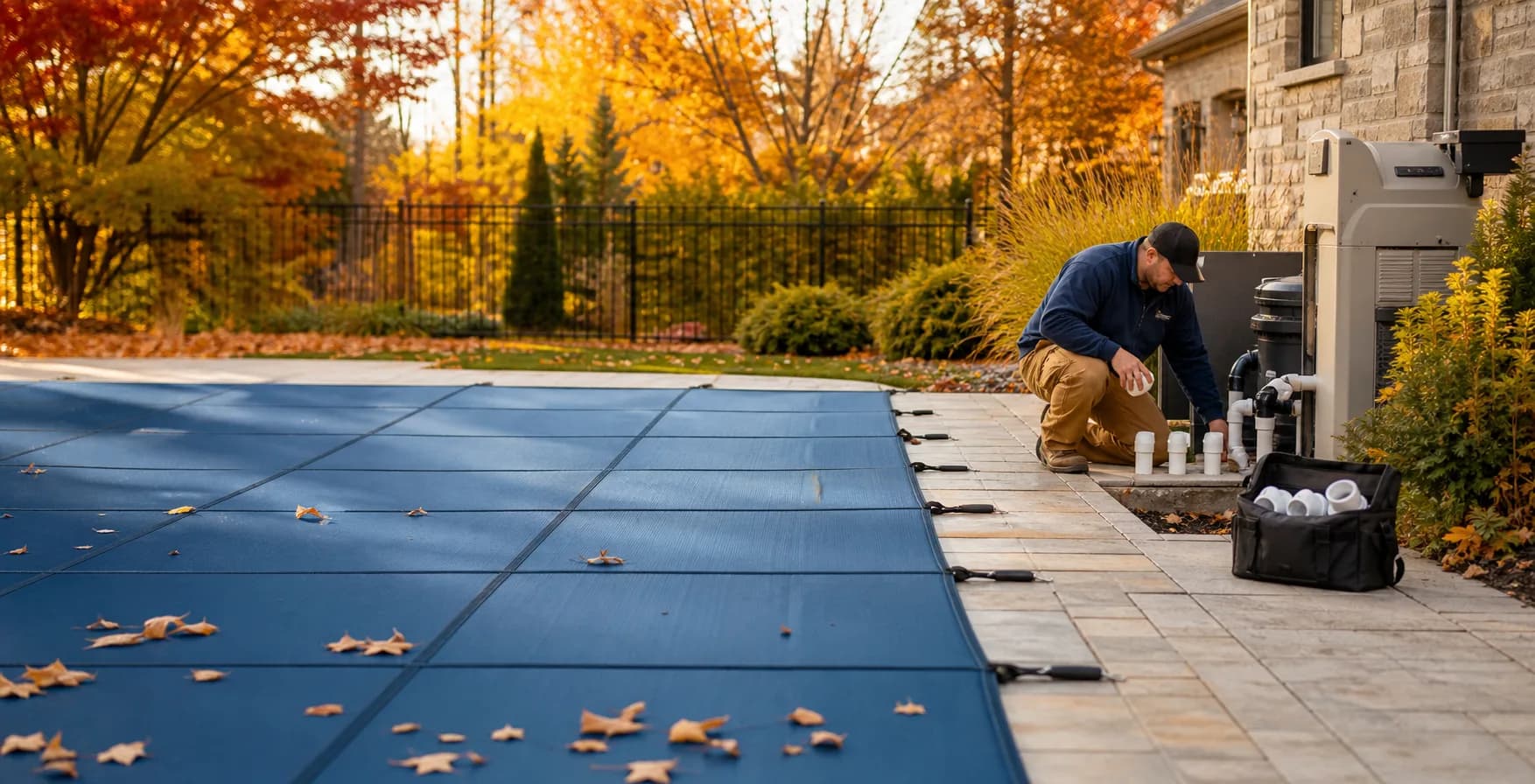
Close the pool when the water has cooled sufficiently and you have a clear frost-protection procedure for the system. Before covering it, clean the pool and filter, test and prepare the water, then drain or protect pipes, pump, filter, heater and accessories as their manufacturers require. Do not completely drain an in-ground pool without professional assessment: groundwater can damage or lift the shell. Continue checking the cover, water level and equipment area during winter.
Written and edited by: Pool Explained editorial team
Choose the closing time and method for your pool
There is no single closing date that suits every location. Closing while the water is still warm gives algae and other biological activity more time to develop under the cover. Waiting for a serious frost, however, may leave too little time to protect pipes and equipment. Follow water temperature, the forecast and the recommendations for your system.
Permanent in-ground pools usually retain water, while some above-ground pools are drained, dried and stored. Leave an above-ground model assembled only if its manufacturer explicitly permits it. The exact model's instructions take priority because liners, frames, connections and filters differ.
List everything connected to the water: skimmers, returns, pump, filter, heater, chlorinator, solar collectors, spa area and water features. Any branch can retain water. For a complex installation, call a technician familiar with it. A partly drained pipe can still freeze and split at its lowest point.
Before starting, photograph valve positions and connections. Prepare labels for drain plugs, the pressure gauge, baskets and removed fittings. A few minutes spent on this in autumn can prevent incorrect connections and a search for unidentified parts in spring.
Clean the pool and filter before closing
Before the final treatment, remove leaves, vacuum the floor and brush the walls, steps and waterline. Clean the skimmer and pump baskets. Dirt left beneath a cover for months consumes sanitiser, causes stains and makes spring opening harder.
Prepare the filter according to its type. Backwash a sand filter if required, then drain it as instructed for the model. Remove, wash and inspect cartridges, and dry them if they will be stored outside the housing. Always switch off the pump and release pressure before opening a valve, plug or lid on a pressurised filter.
Test the water and make adjustments suitable for the lining, sanitising system and products you use. A winterising product does not replace cleaning and testing. If a stronger treatment is needed, allow enough circulation time before shutting down, and check compatibility with the pool and cover.
Do not increase the dose simply because the pool will be unused for months. Excess concentration or an incompatible combination can fade a liner, damage equipment or form deposits. Calculate the dose from volume and the label. Keep products separate and never mix them in one container.
Remove water that could freeze inside pipes and equipment
Water expands as it freezes and can crack a pipe, pump housing, filter, valve or heater exchanger. Drain, blow out and seal the installation according to its design and equipment instructions. An incorrectly pressurised compressor or blower can be dangerous, damage components or leave you wrongly believing that a pipe is empty.
Remove the specified drain plugs from the pump, filter, heater and chlorinator. Set a sand filter's multiport valve to a winter position only if that model has one and its instructions require it. Store the gauge and sensitive parts somewhere dry with clearly labelled plugs.
There is no universal amount by which to lower the water. The required level depends on the structure, skimmers, jets and cover type. Completely draining an in-ground pool can be risky where there is groundwater or external soil pressure. If you do not know the design, let the installer or another qualified professional decide.
For an above-ground pool that will be stored, wash and completely dry the parts before packing. Fold the liner as instructed, without sharp creases and at a temperature where the material remains flexible. Store the pump, hoses and accessories away from frost, damp and rodents. A damp cover or hose sealed in a box can soon develop mould and an unpleasant smell.
For a saltwater system, check the cell's winterising instructions and any winter salinity requirements. Solar collectors, heat pumps and heat exchangers have their own drain points too. Closing the main filter does not mean every connected device is free of water.
Check the cover and pool area throughout winter
Winter covers, safety covers and solar blankets serve different purposes. A bubble-style solar blanket does not protect against falling into the water and is not a substitute for a winter cover. Anchor and tension a safety cover as instructed. A tarpaulin does not become a safety cover simply because it looks strong.
After strong wind, rain or snow, check the cover's position, anchors and straps. Remove water and debris with equipment intended for that cover, and do not walk on it. Some covers rely on the water beneath them for support, so do not alter the level without checking the instructions.
Inspect the equipment area for water, rodent activity and damaged insulation or cables. Check drainage around the pool too. Winter rain collecting beside the equipment area or foundations can cause problems even when the pool plumbing was winterised correctly.
Keep a final checklist of closed valves, removed plugs, stored parts and the water level left in the pool. These records make reconnection easier in spring and help you identify damage immediately.
In an unusually mild winter, do not reopen the plumbing merely because the water looks good beneath the cover. Keep the system winterised until planned opening unless its instructions and weather conditions clearly allow otherwise. After any temporary change, restore frost protection before the next freeze.