Surface finish
The factory-made internal surface should be even, smooth and undamaged. Its appearance alone does not tell you the quality of the layers beneath it.
Prefabricated composite shells
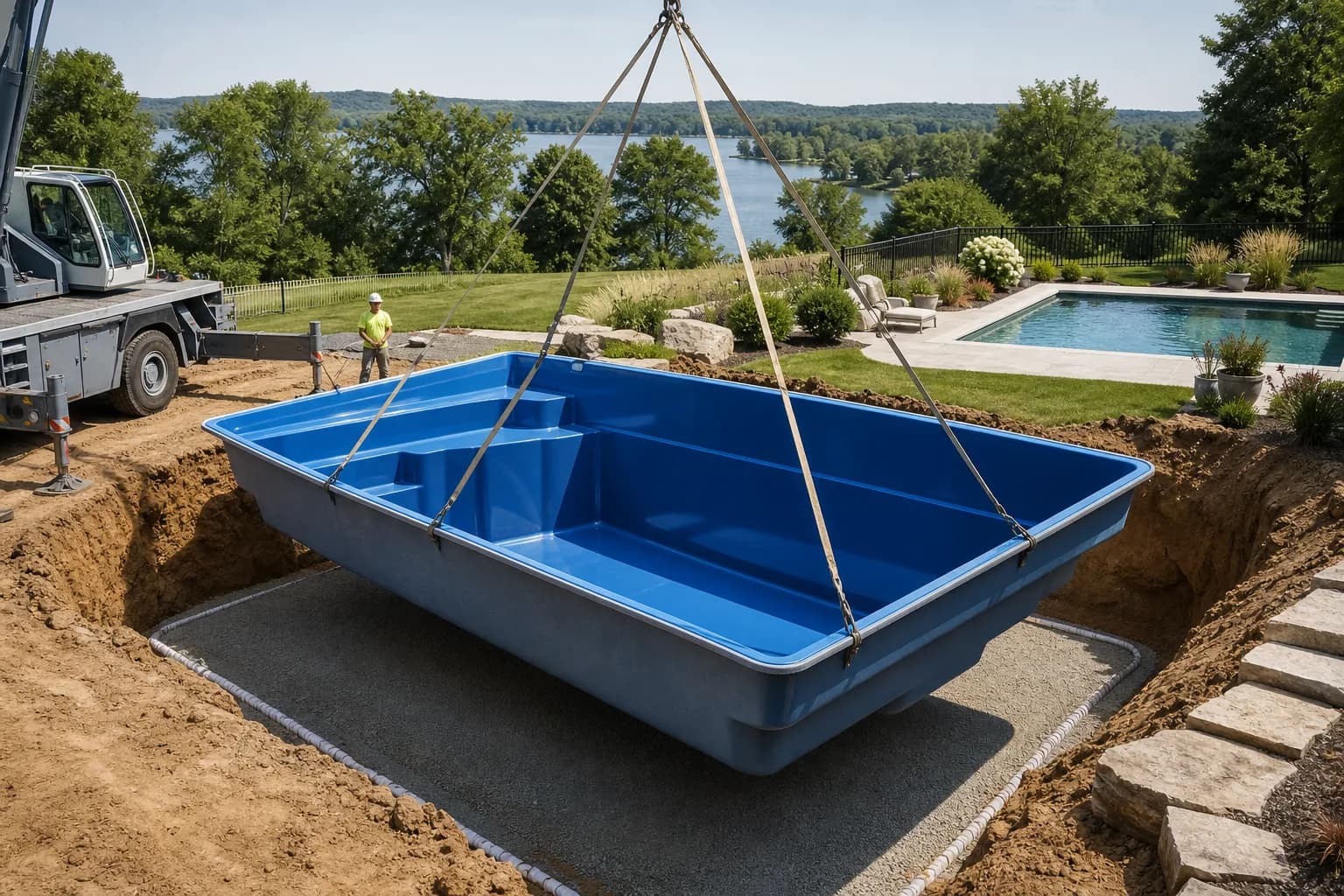
A fibreglass pool can be installed faster than one built entirely on site. Before ordering, check the ground, truck and crane access, base preparation, drainage and complete scope of work.
Shell construction
Fibreglass, composite and polyester pools are not three entirely separate constructions. Composite is the broader technical description, fibreglass refers to glass-fibre reinforcement, and polyester usually describes a resin or a marketing category. Check the exact materials in the model's documentation.
The factory-made internal surface should be even, smooth and undamaged. Its appearance alone does not tell you the quality of the layers beneath it.
Resins and glass fibres form a rigid structural shell. Layer arrangements, thicknesses and materials vary by manufacturer. Assess the documented system, not its colour or marketing name.
The shell is not designed to span arbitrary gaps. The prepared base, side backfill and areas around fittings must support it evenly as the manufacturer specifies.
Approval of the shell does not approve the entire installation. Pipes, electrics, pumping, heating, paving, drainage and ground conditions need their own checks against local rules, the design and manufacturer instructions.
The number of layers alone tells you little. Ask who designed the system, how it was tested and who takes responsibility for installation on your site.
Before ordering
Compare water length and width, depths, floor slope, benches and steps. Large outside dimensions do not necessarily mean ample swimming space.
The shell arrives as one large piece. Record road and gate widths, buildings, cables, tree canopies and neighbouring boundaries. The contractor should confirm the truck route and crane position.
Fill, clay, loose soil and wet ground affect the design. Base preparation, drainage and water control must follow site conditions and system requirements, not be decided from a photograph.
Clarify responsibility for excavation, soil removal, crane hire, bedding, backfill, pipes, electrics, paving, first filling and commissioning.
Choosing a model
Catalogue dimensions are not the same as water area. Technical drawings, internal measurements and trying a display model give a better impression than a photograph.
For swimming, choose a model with enough uninterrupted length. Wide benches and steps are comfortable but reduce that space. Check technical drawings with internal dimensions at the waterline and floor.
A constant depth is predictable for family use. A sloping floor provides different depths but changes footing. Steps should be visible, slip-resistant and well lit.
A standard skimmer shell is simpler to install. An overflow arrangement needs additional plumbing, a balance tank and structural details designed for that model.
Finish colour, depth, sky and surroundings all affect the water's appearance. View samples outdoors and check the manufacturer's information on shade changes and care.
Work that will be concealed
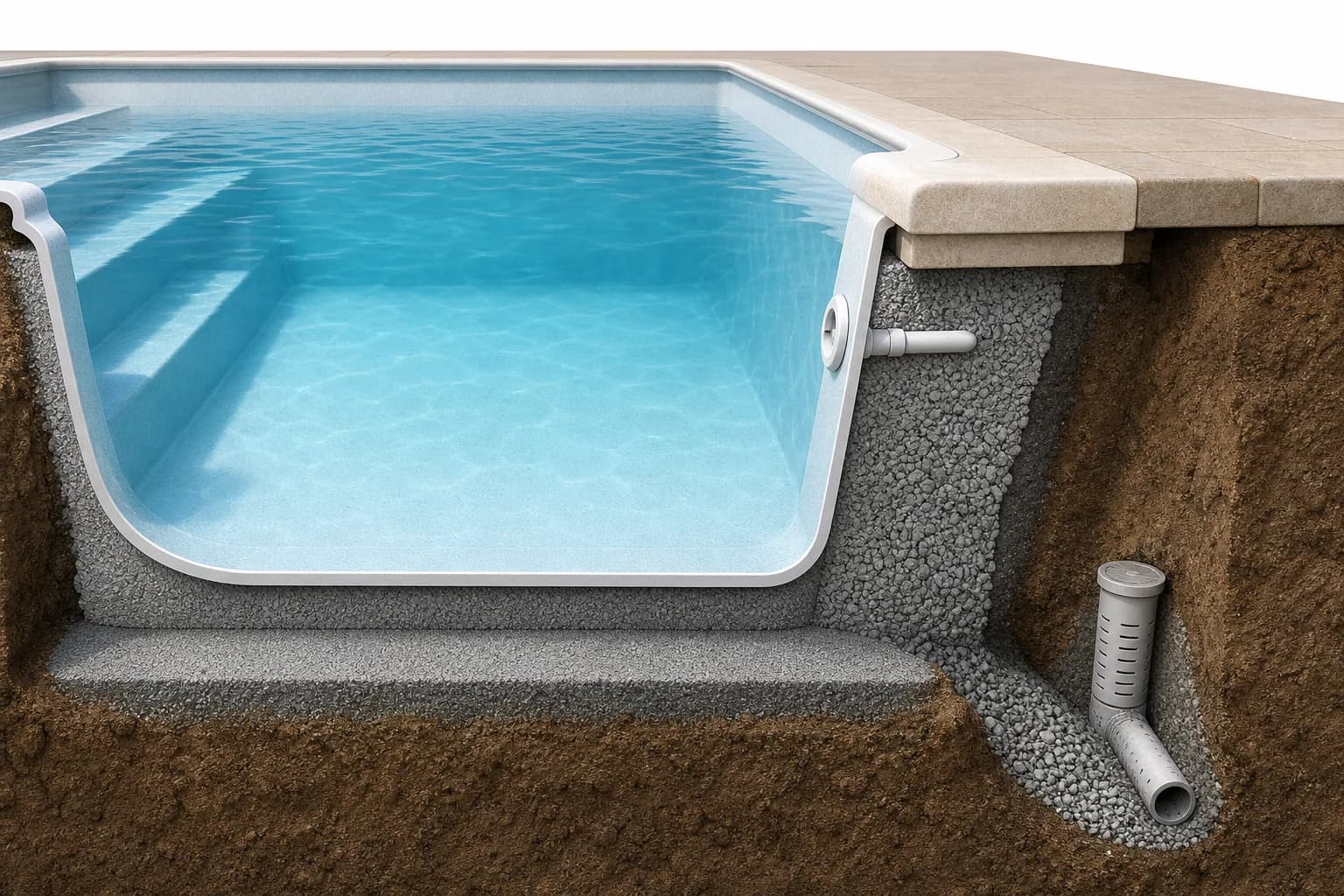
Once paving is finished, you cannot see the base, joints or side backfill. Inspect and document them while they are accessible.
Pool water pushes from inside the shell, while soil and groundwater act outside. An uneven base, backfill voids or inadequate groundwater control can expose the shell to loads it was not designed to carry.
Drainage details vary by site. Follow the soil conditions, groundwater level and manufacturer's documentation. At handover, ask where inspection or drainage pipes are located and who may use them.
Installation stages
This is an inspection overview, not a DIY installation manual. The manufacturer, designer and qualified contractor specify dimensions and materials.
Quality checks
Inspect for transport damage, confirm fitting positions and base levels, and check excavation dimensions and drainage plans.
Ask for tests and photographs of pipe routes, valves and shell penetrations. Checking now costs far less than investigating after completion.
Monitor levels, distortion and the even progression of filling. Use the materials and placement method specified for the system.
Collect manuals, warranties, equipment details, concealed-service drawings, initial settings and instructions for winterising and any permitted draining.
After installation
A smooth finish is generally easier to brush and clean. You still need effective circulation, filtration, pH testing and disinfection.
Extreme readings or a prolonged imbalance can damage equipment and the finish. Base doses on tests and product instructions, not guesswork.
Pool water and groundwater exert different pressures. Do not empty the pool without following the manufacturer's procedure and obtaining a professional assessment of groundwater conditions.
Some localised damage can be professionally repaired. If you notice discolouration, a blister, crack or distortion, identify the cause and check warranty terms first.
Possible problems
Pause further work, record the condition and find the cause before repairing visible damage.
Unsuitable material, water washing out backfill or poor installation can leave uneven support. Find out why the support failed before repairing visible damage.
Unbalanced filling and backfilling, an unsuitable base or external pressure can change the shell's shape. Stop work immediately and contact the responsible professional if you notice distortion.
Photograph and mark the area, then contact the installer and manufacturer before sanding or patching. Preserve evidence and establish the cause for a warranty assessment.
Paving needs correctly designed support, movement joints and drainage. A rigid connection not permitted by the manufacturer can impose extra loads on the shell.
Reviewing the quote
Get written answers specific to the model, site, installer and warranty.
FAQ
Not in the usual sense of that term. It is a factory-moulded composite shell made from resins and glass fibres, with a surface finish. Assess the quality of the specific product and its documented construction.
Lowering the shell can be quick, but the whole project includes delivery planning, excavation, foundations, services, controlled backfill, paving, equipment and handover. Short advertised times often exclude some of these stages.
No. Shell shape is only one consideration. Soil, groundwater, slopes, access or local rules may require additional design work, and sometimes another pool system is more suitable.
Do not treat draining as routine. External soil and water pressure can become critical when the pool is empty. A professional should follow the manufacturer's procedure for actual site conditions.
Do not assume a lower dose. Chemical demand depends on volume, swimmers, temperature, sunlight, covers and filtration. The main advantage of a smooth surface is easier physical cleaning.
Fibreglass has a factory-made shape and generally a quicker installation. Concrete offers more freedom over dimensions, depth and details. Compare site access, soil, desired shape, contractor, budget and future maintenance.
Comparison