Pool Explained
SR
Pool types

Seasonal and semi-permanent pools

Above-ground pools: types, selection and setup

Check the structure, actual dimensions, base strength and level, filtration capacity, safe access and storage or winter care before choosing.

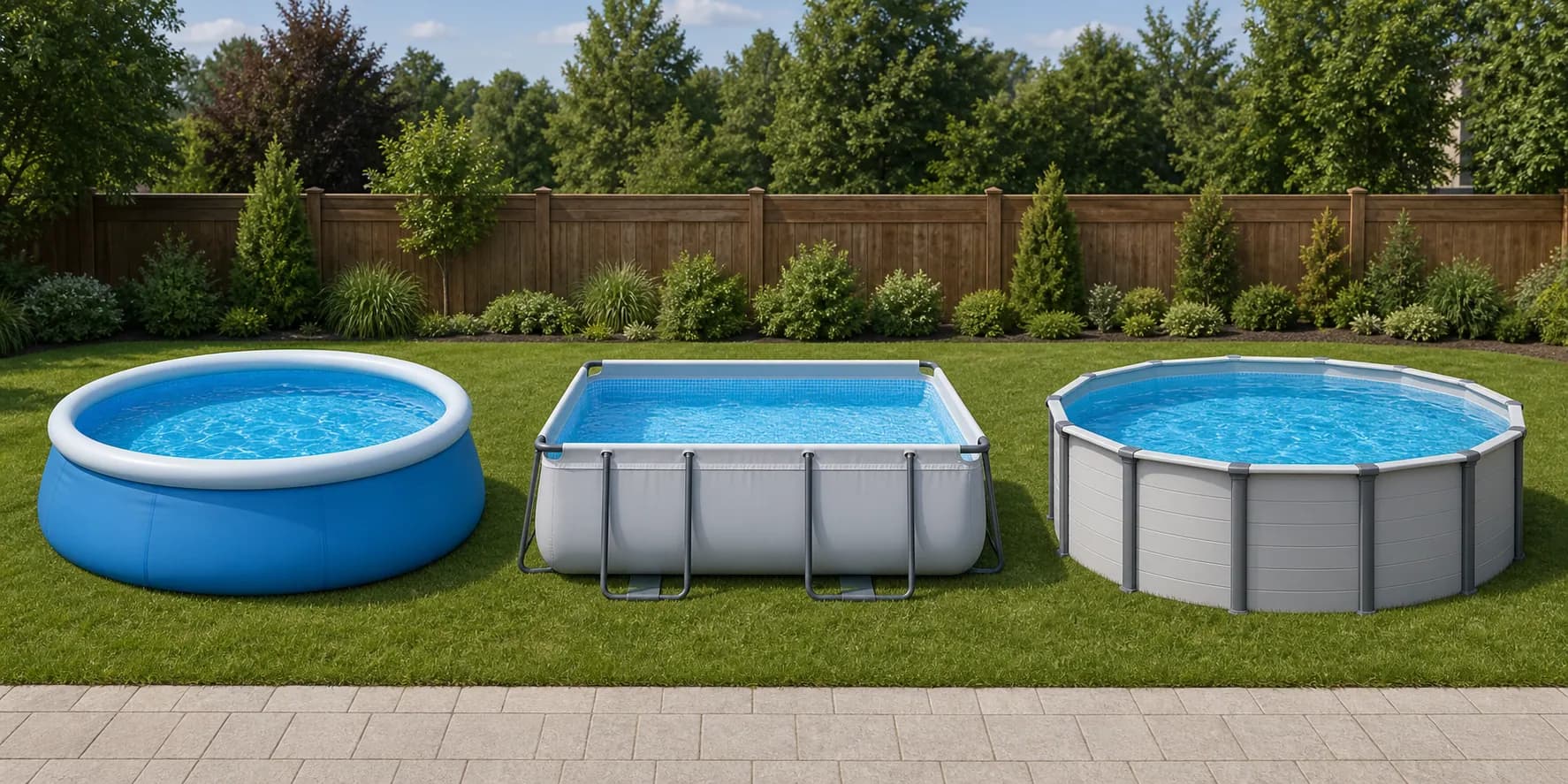
Comparison of above-ground pool structures in a garden

Types of construction

What types of above-ground pool are available?

Inflatable-ring, metal-frame, DWF and rigid-wall pools differ in stability, footprint and storage. Choose a suitable construction type before deciding on size.

Inflatable-ring pool

The soft liner takes shape as water rises and the top ring floats. These pools are quick to set up and usually cost least, but are more vulnerable to an uneven base, punctures and distortion. Do not lean, sit or climb on the wall.

Metal-frame pool

Steel tubes and legs support a multilayer liner. This structure is firmer, comes in more sizes and can accommodate larger filtration systems, but every leg needs even support. Inspect joints for corrosion, liner fit and any settling feet.

DWF / drop-stitch pool

Thousands of internal threads connect the two wall faces. At the specified pressure, they form rigid, flat walls without an external frame. The folded pool is compact to transport, but needs careful valve handling, pressure checks and a larger initial budget.

Rigid-wall pool

Segmented or rolled metal walls, a top rail and an internal liner make a more permanent installation. It can resemble a traditional pool and stay assembled longer, but requires careful planning for the base, installation, local rules and winter care.

An important distinction: frame and ring pools are generally seasonal products; DWF is portable but built differently; rigid-wall pools are closer to a semi-permanent installation. Check whether the exact model must be dismantled or can remain in place over winter.

Choose for your needs

Do you really need the largest model?

Every extra cubic metre adds ground load, filling time, filtration demand and seasonal cost.

For occasional summer use

A small ring pool or basic frame model uses less water and fills faster. Check whether a pump is included and how often filter cartridges need replacement.

For regular family swimming

Prioritise a stable frame, secure ladder, sufficient surrounding space and filtration sized for the water volume. Usable area and safe entry matter more than depth alone.

For a neater, longer-term setup

Consider DWF or rigid-wall models if you can budget more and arrange careful installation and servicing. Check replacement liners, valves, connectors and other parts before buying.

Base preparation

The base must be level, smooth and strong enough

Each cubic metre of water weighs about a tonne. The ground and every frame foot must support that load evenly.

Check the full area occupied by the liner, external legs and service clearance. Keep away from climbable objects, overhead power lines and buried services. Plan where rainwater, overflow and drained pool water will go.

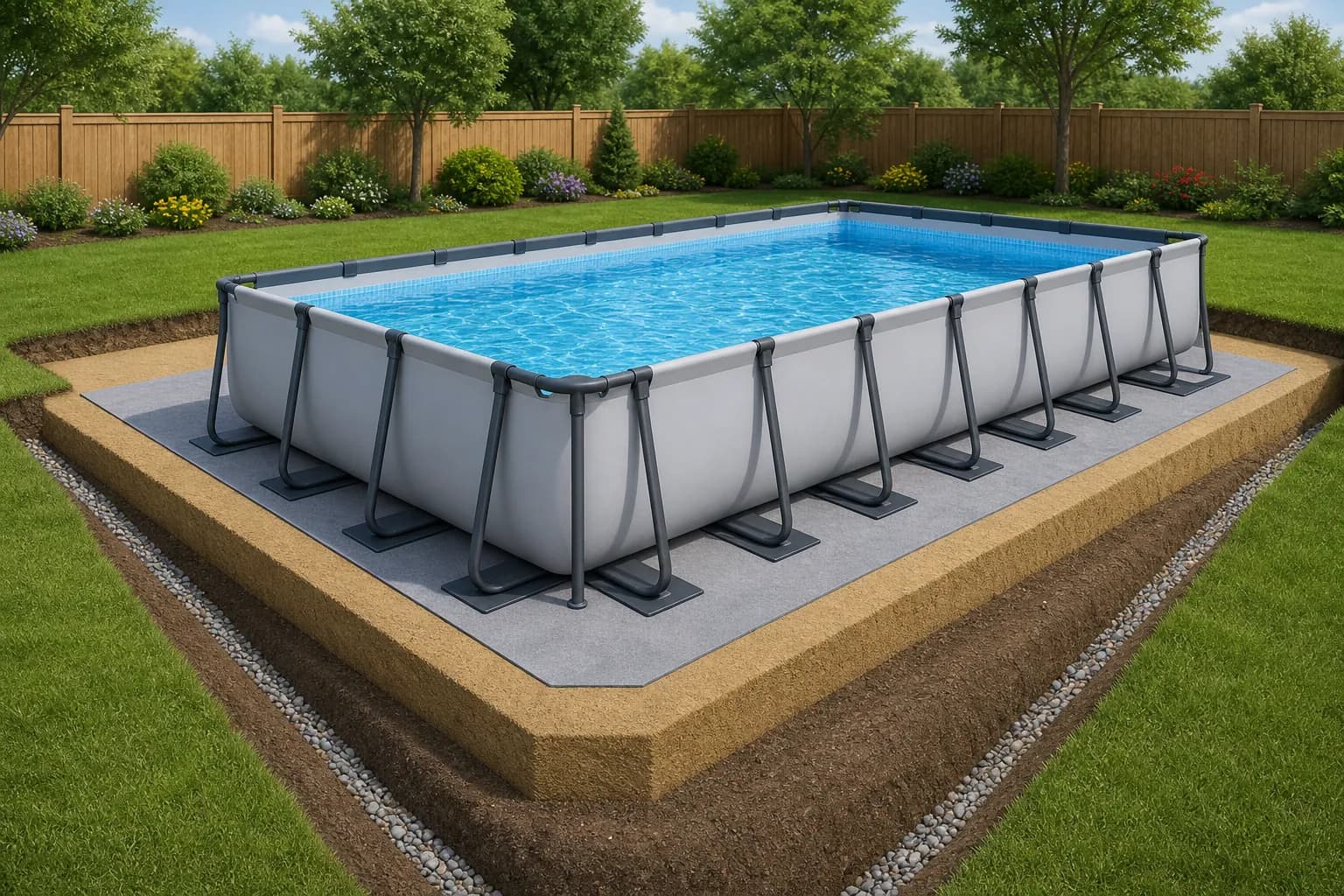
Remove high spots to form a stable level rather than raising the low side with improvised fill that can wash out or settle. A groundsheet prevents abrasion but does not level the site. Leg supports must be firm, flush with the floor base and positioned so they cannot rub or cut the liner.

A concrete base must be smooth, level and permitted by the manual. Never assess a terrace, balcony or raised platform by eye: its ability to carry water, swimmers and dynamic loads must be verified.

Diagram of a level above-ground pool base and frame supports
Illustration of the principle: a level load-bearing area, protective groundsheet and firm support beneath each leg. Follow the model instructions and soil conditions for the actual layers.

Installation

Watch the frame, legs and liner while filling

Take your time and follow the exact model's manual. Once the pool is full, even a small positioning error cannot safely be corrected by hand.

  1. 1Unpack and identify all parts against the model's manual before unfolding the liner.
  2. 2Recheck the entire base for level and remove stones, roots, twigs and sharp objects.
  3. 3Lay the protective groundsheet, but do not use it to compensate for a slope or soft ground.
  4. 4Assemble the frame without forcing it. Check joints, tees, feet and water inlet and outlet positions.
  5. 5Add only a few centimetres of water, smooth the floor and check for an even waterline on every side.
  6. 6Continue filling while checking legs and side supports. If a foot sinks or the frame goes out of level, stop filling and drain as instructed.
  7. 7Connect filtration with the specified hoses and clamps, then check connections and the electrical supply against the equipment instructions.
  8. 8Before swimming, test the water, secure access and remove tools, packaging and objects children could climb.

Equipment

What equipment does an above-ground pool need?

The kit price may not cover the complete working setup. Check fittings, pump and filter capacity, consumables and everyday access space.

Pump and filter

A pump's rated flow applies under specified conditions; installed flow is usually lower with hoses and a dirty filter. For larger pools, check that pump and filter capacity suit water volume and expected use.

Learn more

Ladders and access control

The ladder must suit the wall height, stand securely and be assembled exactly as instructed. When the pool is unused, lock, secure, remove or fence off access as required by the system and local rules.

Cover and groundsheet

A groundsheet protects against abrasion and minor surface marks; it does not support the structure or level the ground. A cover reduces leaves and heat loss, but an ordinary debris cover is not a safety barrier.

Cleaning and testing

A net, liner-safe brush, vacuum and reliable water test kit are basic essentials. Have replacement cartridges, seals and patches available before you need them mid-season.

Safety

A high wall does not replace supervision or barriers

Children can climb ladders, pumps, furniture and other nearby objects. CPSC guidance calls for controlled access: the pool structure and any additional barrier should work together, with steps or ladders secured, locked, removed or fenced off when unused. Local rules may be stricter.

An adult must closely and continuously supervise children in the water. Remove toys that could attract children after swimming. Do not dive into a shallow above-ground pool, sit on a soft wall or use the frame as a handrail. Keep rescue equipment and a way to call for help accessible, but never treat them as a substitute for supervision.

Connect electrical equipment according to its instructions and local rules, without improvised extension leads beside the water. If you are unsure about protective devices or outlet location, use a qualified electrician.
Water care

Even a small pool needs regular maintenance

Sunlight, heat, swimmers and dirt can quickly affect a small volume of water. A clear appearance does not prove that water readings are acceptable.

During the season

  • • Check clarity, water level, baskets, hoses, connections and return flow.
  • • Test regularly, and more often during hot weather or heavy use.
  • • Clean or replace filter media according to pressure, flow and the manual.
  • • Remove leaves, brush deposits and vacuum before contamination builds up.
  • • Add products separately according to their labels and pool volume; never mix them.
Water chemistry guide →

If the water becomes cloudy

Do not automatically add more chlorine. Test first, check that the pump draws and returns water, clean the filter and assess filtration hours. Cloudy and green water can look similar at first but do not always need the same treatment. Find the cause before dosing.

Before buying

How much space does an above-ground pool really need?

Catalogue dimensions often describe only the liner or internal space. Legs, braces, hoses, a ladder and access around the pool increase the footprint.

Footprint and access

Mark the outer ends of every leg and brace, not just the water dimensions. Leave a route for an adult to inspect joints, clean and reach a child without climbing over the frame. Gates and the delivery route must accommodate boxes and long frame sections too. Check ladder positioning and whether it can be safely removed or locked.

Water, electricity and drainage

Estimate hose length, filling time and water availability throughout the season. Position the pump within its hose limits, with ventilation and without creating a trip hazard. Plan discharge for overflow, filter cleaning and final draining without undermining feet or flooding the house or neighbours.

Servicing and replacement parts

Before paying, find the model number, digital manual and parts list. Check connection sizes, filter media, seals, valves, patches and replacement liners. A cheap kit can become expensive if a non-standard fitting is unavailable mid-season. Keep the receipt, serial number and a packaging photo for warranty claims and parts orders.

Total budget

What to include in an above-ground pool budget

Buying the pool

Compare actual kit contents: pump, filter type, ladder, groundsheet, cover, hoses and connectors. Similar-sized kits can need very different extras.

Preparing the location

Allow for removing high spots, compaction, level checks, supports beneath legs and drainage. Poor preparation can damage the liner or frame.

Seasonal running costs

Water, electricity, filter media, tests, treatment products, cleaning and any heating are recurring costs. A larger water volume increases most of them.

End of the season

For a dismantled pool, allow time for draining, cleaning, thorough drying and dry storage. For a model left outdoors, follow its winter instructions.

End of the season

Prepare the pool for storage

Plan dismantling while the weather is still warm enough to dry the liner and joints thoroughly.

Choose a safe, permitted discharge point before opening the drain. A large release can undermine the pool, flood neighbouring land or damage plants and buildings. Follow local rules for treated pool water.

Disconnect equipment and drain hoses and components in the specified order. Clean the liner without abrasive tools and let it dry fully. Damp folds encourage mould and sticking, while wet metal joints corrode. Label bags of small parts and do not put the heavy frame on the folded liner.

Store everything in a dry enclosed space, protected from rodents and large temperature changes, within the manufacturer's range. Bestway instructions, for example, require clean, dry parts and suitable storage temperatures, but follow your own model's manual.

Common mistakes

Eight mistakes that can damage the pool

1

Raising only the low side with loose material instead of preparing a stable, level base.

2

Installing on soft, muddy or unsuitable ground that loses strength when wet.

3

Buying the largest pool that fits without allowing for frame legs, pump, drainage and safe access.

4

Relying on the supplied pump without checking volume, actual flow and replacement filter availability.

5

Continuing to fill when the waterline is uneven or a leg starts sinking.

6

Leaving ladders and climbable objects accessible to children when no adult is supervising.

7

Mixing chemicals or storing them in a damp, hot or unsecured place.

8

Packing damp liners and components, encouraging mould, odours, sticking and corrosion.

Next steps

Compare sizes, costs and other options

FAQ

Above-ground pools: common questions

Can an above-ground pool go straight on grass?

Only if the model manual permits it and the soil is level, smooth, stable and free of roots or objects that could puncture the liner. Grass does not correct unevenness; rain and pool water can soften soil, so support must remain even.

Can I use sand to level the garden?

Do not rely on loose sand beneath the low side. It can wash out or shift under heavy loads. Follow the pool manual and prepare a load-bearing, compacted, level surface. Get specialist groundworks advice for substantial alterations.

How level must the base be?

Follow the tolerance for your exact pool. For example, one Bestway frame-pool manual illustrates a maximum difference of 2 cm, but this must not be applied to every product. Your model's instructions take priority.

Is the supplied pump always adequate?

Not necessarily. Check water volume, rated and expected actual flow, filter capacity, filtration hours and replacement media. More swimmers and hotter weather place greater demands on the system.

Can an above-ground pool stay filled over winter?

It depends on construction, climate and the manufacturer's explicit instructions. Many seasonal liner and frame pools must be dismantled; some rigid systems have winterising procedures. Freezing, snow and incorrect draining can damage the liner, valves and frame.

How should I store the liner?

Drain to a permitted location, clean gently using an approved method and dry completely. Fold carefully, store metal components separately and keep everything dry within the manual's storage temperature range.

Will a cover keep a child out of the pool?

An ordinary debris cover does not replace supervision, fencing or an approved safety system. Control ladder access to above-ground pools and comply with local barrier requirements.

When should I stop filling or using the pool immediately?

Stop if the waterline is visibly uneven, a leg sinks, the frame bends, a joint leaks, the liner stretches incorrectly or electrical equipment behaves unusually. Do not repair the structure under the full load of water.