Supporting structure
Steel or composite panels, masonry or reinforced concrete walls and the floor slab carry water and ground loads. A liner cannot correct a moving, unsupported or inadequately designed structure.
Replaceable PVC-P lining
A liner is the watertight internal finish, not the pool's supporting structure. Its service life depends on a smooth base, properly fitted penetrations, controlled water chemistry and skilled installation.
This guide draws on technical sources and system-specific documentation.
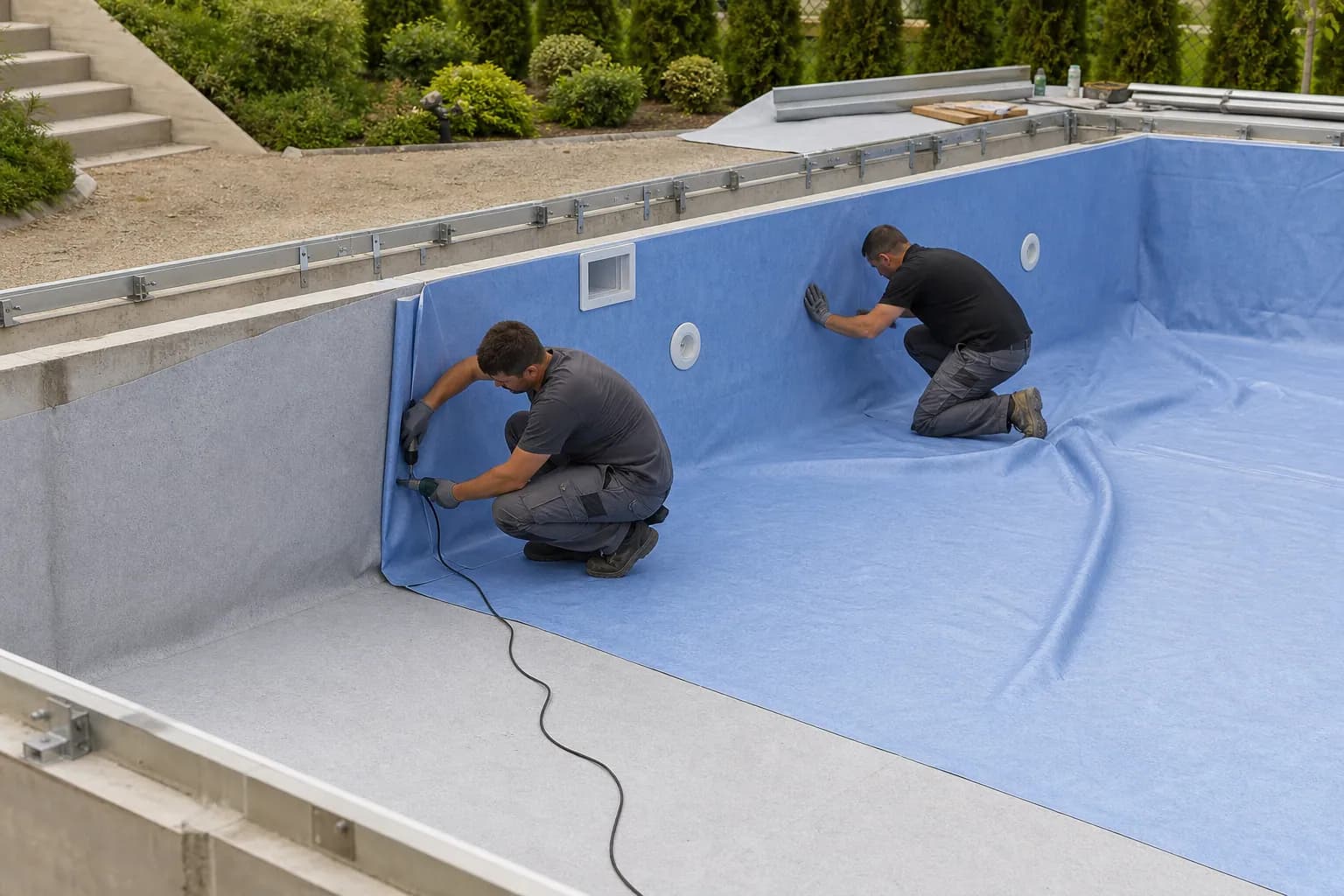
The basic distinction
A liner is the internal waterproof and decorative finish. It does not replace the structure, insulation, drainage or repairs to a defective shell.
Two related but different products are often sold under the same name. A factory-made liner is measured and welded in the factory, hung in a perimeter track and seated with controlled vacuum before filling. Reinforced membrane arrives in rolls, usually with polyester reinforcement, and is cut and hot-air welded on the shell. It accommodates complex steps and irregular shapes more readily, but needs a trained welder and inspection of every joint.
Thickness matters, but is not a quality rating by itself. PVC-P formulation, reinforcement, pigments, protective coating, dimensional stability, weldability, substrate compatibility and well-fitted penetrations all affect the result. A quote stating only 1.5 mm liner does not fully specify either the product or the pool.
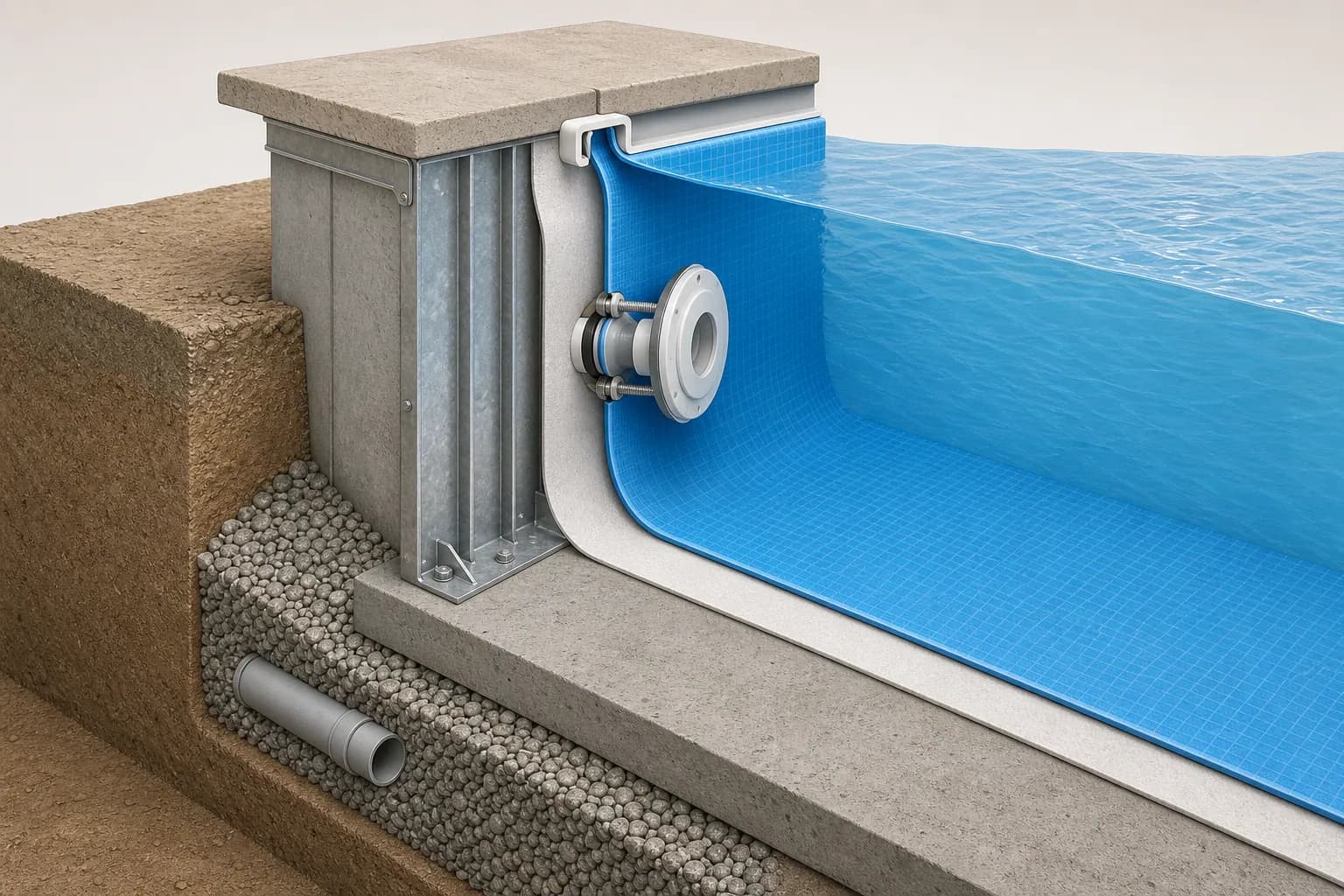
Steel or composite panels, masonry or reinforced concrete walls and the floor slab carry water and ground loads. A liner cannot correct a moving, unsupported or inadequately designed structure.
The surface must be firm, smooth, clean, free of sharp edges and chemically compatible. Protective underlay separates the membrane and softens minor marks, but cannot hide large irregularities, cracks or poor transitions.
Flexible PVC-P forms the final watertight surface. A factory-made liner hangs in a retaining track and is held against the base by water; reinforced membrane is cut from rolls and hot-air welded on site.
The retaining track, skimmers, returns, lights, drains and steps must be compatible with the liner system. Gaskets and flanges clamp the lining mechanically; silicone is not a substitute for a correctly assembled fitting.
Beneath the lining
The structure affects preparation, installation time, future repairs and contractor responsibilities. Before fitting the membrane, make sure the base is stable and correctly prepared.
Modular wall panels allow accurate shapes and quick assembly, but need designed connections and bracing, a stable floor slab and controlled backfill. Corrosion protection and fitting compatibility must be documented.
Concrete and masonry allow a wider range of shapes, steps and depths. Before lining, the structure must be stable, sufficiently dry, repaired and smoothly finished. Covering an active structural crack with a membrane does not repair it.
Reinforced membrane can be a practical finish for a sound older shell, including one previously finished with another material. First assess moisture, cracks, penetrations, compatibility and the cause of any earlier leaks.
The base and lining material
Water presses the flexible lining against its base. Irregularities, joints and sharp transitions underneath can become visible over time.
Protective underlay improves the feel of the surface, separates incompatible materials and reduces minor abrasion. It cannot level a wavy wall and must not be left creased. On walls, secure it with an approved product and avoid raised joints beneath the membrane.
Darker linings produce a stronger water colour, but scale, fading and local changes show differently on them. Textured slip-resistant finishes matter on steps but take more cleaning. Choose samples with lighting, depth, cleaning and ageing in mind, not just the catalogue image.
Measuring and installation
Use this list to follow the installer's work, not as DIY welding or fitting-cutting instructions. The wrong sequence or temperature can damage the lining and invalidate its warranty.
Penetrations
Every pipe, light and suction opening through the lining needs fittings designed for the specific liner system.
Use liner-compatible fittings with suitable flanges, gaskets and stainless-steel screws. Tighten evenly and cut the opening only once the lining is clamped in the specified sequence.
The cover and configuration must address body, hair and object entrapment and meet local requirements. This is a safety assembly, not merely a decorative floor fitting.
The niche, flange and electrical installation must suit the lining and meet pool electrical rules. Use a qualified electrician.
Changes of plane can create extra stress. Plan cuts and welds to avoid pockets and unnecessary overlaps, and use a slip-resistant finish on steps.
A liner does not prevent drowning. Plan fencing that separates the pool from the house, a self-closing and self-latching gate, close child supervision, slip-resistant access and suitable suction covers. Store chemicals locked away, separately and in original packaging; never mix them. Local construction, electrical and safety rules take priority over this general guide.
Possible problems
Before repairs, record when the problem began, water level, temperature, test results and equipment operation, and take photographs. These details help identify the cause.
These may indicate incorrect measurements, positioning or installation temperature. Wrinkles appearing later can result from chemistry, overheating, water behind the liner or base movement. Find the cause before trying to remove them.
Groundwater, runoff, a leaking fitting or pipe, or overflow can reach behind the lining and lift it into pockets. Do not puncture it at random. Establish the water source, groundwater level and safe repair procedure first.
Compare and record levels to distinguish leakage from normal evaporation. A technician can then test pipes, equipment, fittings, welds and local damage using pressure tests and targeted detection rather than random patching.
Small areas of damage can often be professionally patched, sometimes underwater, if the surrounding lining is sound. Brittle, badly faded or repeatedly repaired membrane may need more extensive replacement.
Possible causes include concentrated oxidisers, metals, waterline deposits, microbial growth behind the liner or incompatible products. Distinguish removable deposits from permanent material damage before treatment.
Do not force it back with tools. Material condition, temperature, shrinkage and track condition determine whether a professional can refit and secure the edge or a larger repair is needed.
Water and temperature
Water must meet swimming requirements and stay within the membrane manufacturer's limits.
Disinfectant and pH are essential to water hygiene. For home pools, the CDC recommends pH 7.0–7.8 and at least 1 mg/L free chlorine, or at least 2 mg/L with cyanuric acid. Also meet any narrower limits in the membrane documentation to protect the finish.
RENOLIT recommends pH 7.2–7.6 for its reinforced membranes, warns against excessive chlorination and cites a maximum temperature of 32°C under the relevant standard. Do not apply this indiscriminately: follow the documentation for your own membrane.
Never leave tablets, granules or liquid concentrate on the lining. Add chemicals exactly as labelled, with circulation and without mixing products. Automatic dosing and salt chlorinators still need manual checks.
Use a soft brush, sponge and liner-approved equipment. Wire brushes, abrasive pads, solvents, damaged cleaner parts and tools resting against the surface can leave permanent marks.
Warmer water speeds up chemical reactions and increases disinfectant demand. It can also increase the risk of wrinkles, fine lines and discolouration in the membrane. Before adding heating, check the maximum continuous water temperature, covering requirements and warranty coverage for that operating condition.
Use reliable tests to monitor pH, free chlorine and alkalinity, and keep a record. Test more often after heavy rain, heavy use or a dosing fault. Adjust gradually, using pool volume and the label: concentrated, undissolved product in one place can permanently damage the finish.
Refurbishment
The new membrane or factory-made liner is only part of the cost. Include safe draining, removal, shell inspection and preparation, new gaskets, refill water and recommissioning.
Consider replacement when the liner is brittle, shrunken, permanently faded, repeatedly patched or no longer seals reliably. Age alone is not a diagnosis, and there is no universal lifespan.
After controlled draining, inspect the base, panel corrosion, cracks, dampness, underlay, tracks, pipes and fitting bodies. Fix the reason for the old liner's failure or water behind it before installing a new one.
Allow for new gaskets and parts accessible only when the pool is empty. Assess flanges, screws, lights and tracks individually; do not assume every old component will remain suitable.
Winter care
The procedure depends on freezing conditions, pipework, the cover and manufacturer instructions. Confirm these points with your installer.
Budget
Size, shape, shell type, steps, fittings, preparation, membrane, access and water volume all affect cost. Written local quotes for the same work are more useful than a single price per square metre.
Initial cost: the structure, slab and preparation often account for a large part of the budget. For refurbishment, allow for unknown substrate repairs instead of assuming they will be minor.
Running costs: water, energy, chemicals, cleaning, covers and servicing depend more on volume and operation than on the name of the finish.
Future replacement: a liner lets you renew the finish without building a new shell, provided the structure and fittings remain sound and compatible materials are available.
Reviewing the quote
Get answers in the contract, technical sheets and warranty. Verbal assurances are not enough when responsibility is shared between the builder, installer and membrane supplier.
FAQ
The terms are often used loosely. A factory-made liner is made to the pool's dimensions. Reinforced PVC-P membrane is usually thicker, reinforced with polyester mesh and welded from strips on site. Ask for the precise product type and data sheet.
Yes, if the lining system is approved for it and the shell is stable, smooth, repaired and prepared. The liner provides watertightness but does not fix structural movement or an active crack.
There is no reliable universal figure. Material, sunlight, temperature, water chemistry, installation, covers and use all affect lifespan. Compare written warranties and exclusions, not just sales promises.
Sometimes, particularly when a new liner is incorrectly positioned. Wrinkles developing later may result from water behind it, chemistry, heat or dimensional changes. Diagnose the cause before trying to smooth them out.
First distinguish evaporation from leakage and record where the level stabilises. A technician then tests pipework, equipment, fittings and lining separately with pressure tests and targeted detection. Draining at random makes diagnosis harder.
Only use a model and brushes approved for the lining. Check wheels, brushes and suction edges: a trapped stone or damaged part can scratch the finish.
Not as routine maintenance. The liner may lose its fit, shrink or be displaced by groundwater. Have a professional plan full draining for the structure, liner condition and site.
Not automatically. It fits complex shapes more easily and is welded on site, but depends heavily on preparation and welding skill. A properly specified factory-made liner can be practical for a regular shape. Choose a complete system and reliable service support, not thickness alone.
Sources
Manufacturer specifications apply to their products. Local requirements and the documentation for your membrane take priority.
Reinforced PVC-P membrane construction and uses, preparation, retaining profiles, hot-air welding, fittings and installation tools.
Open source ↗Manufacturer guidance on pH, disinfection, temperature, cleaning, automatic treatment and risks to the finish.
Open source ↗Public health guidance on regular free chlorine and pH testing in home pools and hot tubs.
Open source ↗Layers of drowning prevention, four-sided fencing, supervision, water hygiene and safe chemical handling.
Open source ↗Comparison