Tablets and granules are not necessarily two forms of the same product. They can contain different active ingredients and available chlorine concentrations, with different effects on pH, hardness and stabiliser levels. Tablets are generally used for slow, routine dosing and granules for faster adjustments, but the label determines how any particular product should be used.
Written and edited by: Pool Explained editorial team
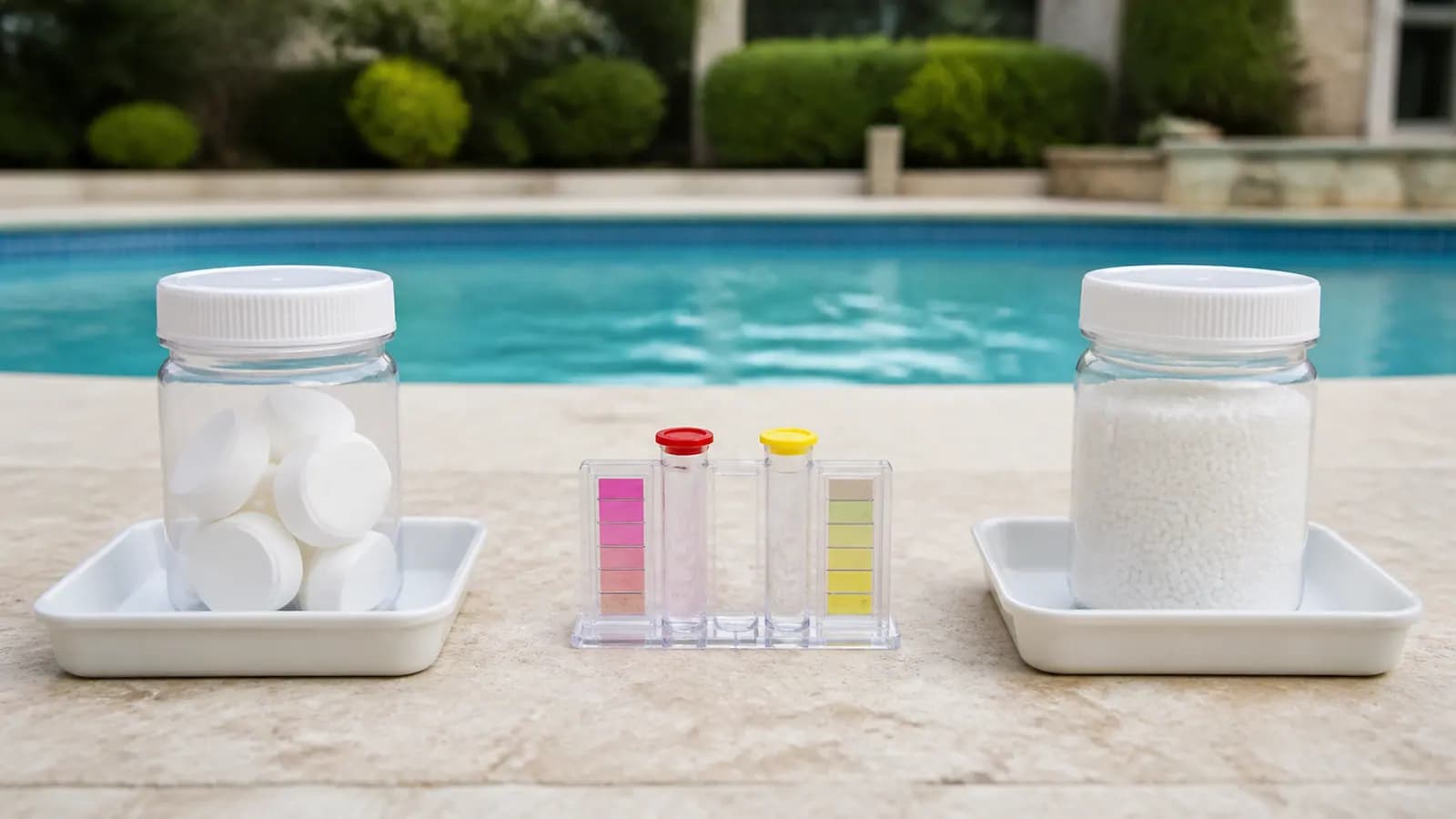
Check the active ingredient, not just the form
Large white tablets sold for home pools often contain trichlor, a slow-dissolving, stabilised chlorine compound. Smaller tablets may or may not contain the same ingredient. Granules might contain dichlor, calcium hypochlorite or another compound. Look beyond the word chlorine: check the active ingredient, available chlorine percentage, dosing instructions and compatibility warnings on the label.
Trichlor and dichlor add cyanuric acid, the stabiliser that protects chlorine from sunlight. This can be useful in an outdoor pool, but stabiliser accumulates over time. The CDC recommends at least 2 ppm free chlorine when cyanuric acid or stabilised chlorine is used, because stabiliser slows chlorine's disinfecting action. Once stabiliser is too high, simply adding more tablets is not a good long-term solution.
Calcium hypochlorite adds no cyanuric acid, but it does add calcium and is a strong oxidiser. This matters in hard water and where scale is a concern. Sodium hypochlorite is liquid rather than a tablet or granule, but it is another reason not to compare chlorine products by weight alone. Different compounds have different effects on the water.
The products also affect pH differently. Stabilised tablets can lower pH during use, while other compounds behave differently. That does not mean you can control pH by choosing a chlorine type and skipping tests. Monitor free chlorine, pH, alkalinity, hardness and stabiliser together, and base each dose on the readings and the product label.
Using tablets for routine chlorination
A slow-dissolving tablet can maintain chlorine between tests when used in a suitable floating dispenser or feeder. The dissolution rate depends on flow, water temperature, tablet size and dispenser settings. There is no universal tablet count: a 15 m³ pool and a 50 m³ pool need different amounts, and two equally sized products can contain different quantities of available chlorine.
Never leave a tablet on the pool floor, a step or a liner. The high local concentration can bleach or damage the surface. Do not put tablets in a skimmer basket unless the pool, pump and chemical manufacturers explicitly permit it. When the pump stops, concentrated chlorinated water can remain in pipes and equipment. Use a feeder designed for the exact type of tablet.
Never add a different chlorine type to a feeder that still contains the previous product. Mixing chlorine compounds can cause fire, a violent reaction or dangerous gas. Empty and clean an old feeder exactly as its manufacturer instructs. If you do not know what was in it, do not add a new product without checking.
Slow-dissolving tablets are not suitable for rapidly correcting very low chlorine or treating a serious algae problem unless the specific product label provides for that use. If a test reveals a problem, identify the cause and use an appropriate treatment rather than simply putting more tablets in the dispenser.
Using granules to adjust chlorine
Granules are often used to raise chlorine more quickly or carry out a shock treatment. You can weigh a dose based on pool volume and the required increase in ppm. However, granules of different compositions are not equally strong: 50 g of a product with 56% available chlorine supplies a different amount from 50 g of a 65% product.
Follow the label for how to add the product. Some granules go directly into pool water; others must first be dissolved. Do not invent your own method. Where pre-dissolving is permitted, slowly add the chemical to clean water in a dedicated container, never water to the chemical. The container must be free of other chemical residues and must not later be used for food, drink or household tasks.
Undissolved granules left on a liner can bleach it. Run the pump as instructed and do not let concentrated product settle in one place. Keep swimmers out until the label's waiting time has passed and a new test confirms acceptable readings. Smell and appearance cannot tell you whether the product has dispersed or the water is safe to swim in.
Do not automatically add the same dose of granules every evening. Sunlight, a cover, swimmer numbers, temperature and debris all affect daily chlorine demand. Test, add the calculated dose according to the label, allow circulation and test again. This helps avoid alternating between too little chlorine and unnecessarily high levels.
Choose a routine that suits your water and equipment
For an outdoor family pool, tablets can be convenient for routine use, with granules used for adjustments after heavy use. This is not a rule for every system. Automatic dosing, a salt chlorinator or a particular pool finish may require a different approach. Check equipment instructions and chemical compatibility before using different products in the same pool, and never mix them in a container or feeder.
If you use stabilised tablets or dichlor, test cyanuric acid regularly. As it accumulates, chlorine works more slowly, and a partial water replacement may become the only practical way to lower it. Switching to unstabilised chlorine does not remove stabiliser already in the water. Consider how much stabilised chlorine you use over the season, not just on a single day.
In hard water, monitor calcium if you use calcium hypochlorite. For sensitive finishes, follow the manufacturer's advice. If white deposits appear, pH rises or the water clouds after dosing, do not just change the dose. Test pH, alkalinity and hardness, and check that the product is suitable for your fill water.
Choose a product you can store safely, measure accurately and monitor through regular tests. Keep chemicals in their original packaging rather than unlabelled containers. Store different products separately, dry and out of children's reach. Before changing chlorine type, record what you have been using and check the correct changeover procedure.