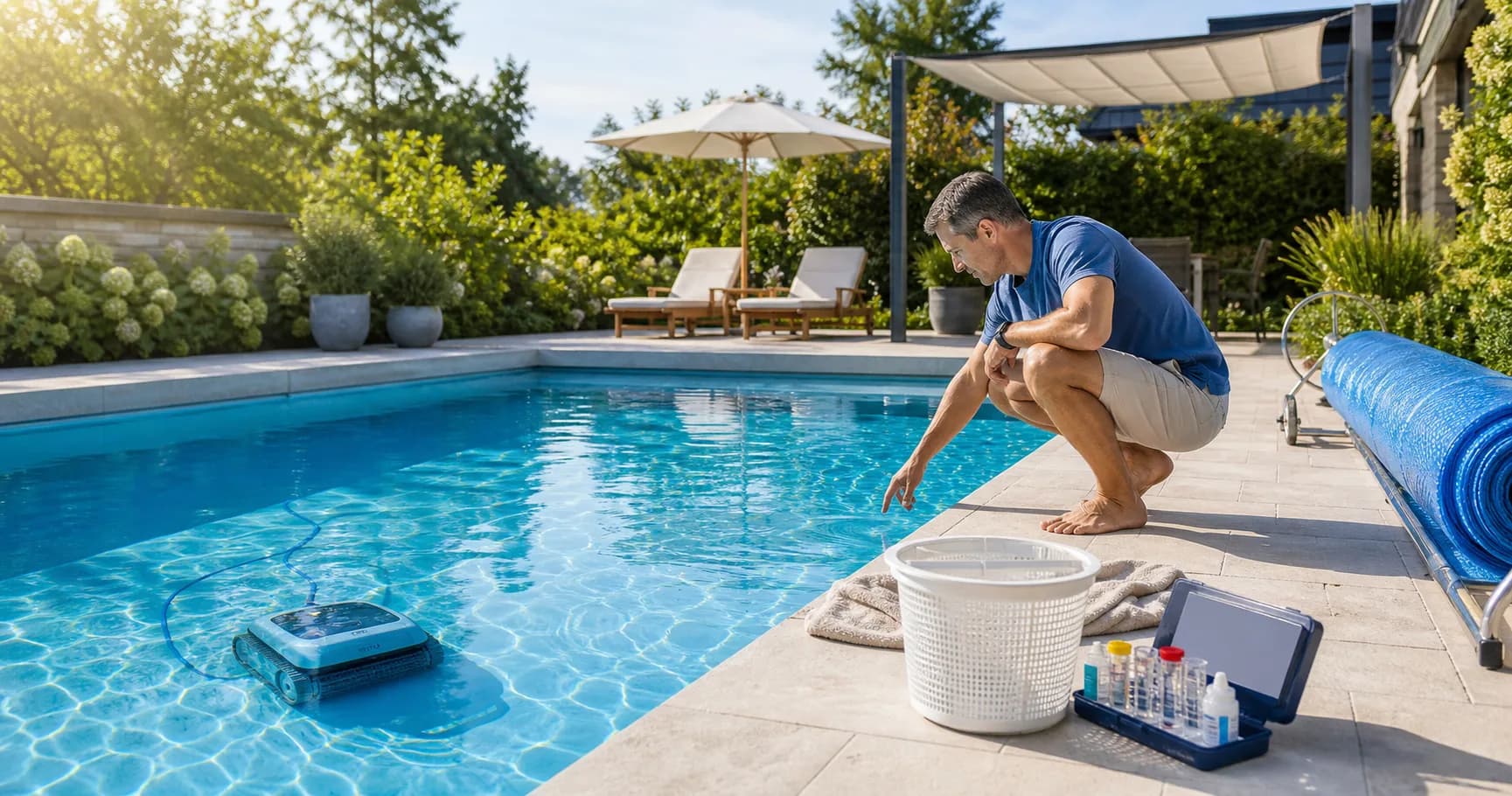
During summer, check water clarity, level and return flow daily, and test the readings required by your system several times a week or more often. Remove debris and empty baskets as needed, clean the filter according to pressure and flow, and adjust pump hours for volume, actual flow, temperature and use. After a storm or a pool party, clean the pool, check circulation and test before adding products out of habit.
Written and edited by: Pool Explained editorial team
Daily checks take only a few minutes
Before swimming, check that you can clearly see the floor at the deepest point. Cloudiness is not just unsightly: it makes a person or object beneath the surface harder to see. If the bottom is not visible, keep everyone out until you have checked water quality, circulation and filtration and restored clarity.
Check the water level and return jets. Low water can let the skimmer draw air, while weaker jets often indicate a full basket, dirty filter, incorrect valve position or suction problem. Listen to the pump too. If it suddenly becomes louder or contains a lot of air, investigate immediately rather than waiting for weekly maintenance.
Skim out leaves and insects and empty baskets before debris restricts flow. Inspect the waterline, steps and corners where dirt collects. Brief, regular cleaning removes material that would otherwise consume sanitiser and end up in the filter.
Look around the equipment and connections. A damp floor, scale around a joint or frequent topping up may indicate a leak. One drip is no reason to panic, but wipe the connection, check it again while the system runs and note whether water returns.
Check the cover, ladders and accessories too. Remove the cover without spilling its dirt into the water, and inspect ladders before use. If children are present, check the gate and supervision every time, regardless of how well the water is maintained.
Adjust testing and filtration to pool use
No testing schedule suits every pool. Extreme heat, many bathers, heavy rain or fresh top-up water can change readings faster than a quiet week. Test often enough to detect changes before water quality deteriorates, and always before a major adjustment. Repeat an implausible result before adding a large dose.
Take samples at a similar location and depth, away from the return jets. Store reagents as directed and replace them before expiry. Strips can provide a quick indication, but use a more precise test before a major adjustment to reduce the risk of dosing from an incorrect reading.
Calculate pump time from volume and actual flow, then adjust it to water conditions. A 24 m³ pool with a measured flow of 6 m³/h has an approximate turnover time of four hours. Warm water, heavy use or clearing cloudiness may require longer running. A universal eight hours means different things for a small above-ground pool and a large in-ground one.
Clean according to the filter type and changes in performance. For a sand filter, compare pressure with the clean baseline and backwash when needed. Remove and rinse a cartridge before dirt severely restricts flow. Cleaning too early wastes water and time; leaving it too late increases resistance against the pump.
After rain or heavy use, check what has changed
Heavy rain can carry dust, soil and organic debris into the pool, raise the water level and alter test readings. Clean the surface and baskets, check drainage and flow, then test the water. Do not add the same chlorine dose after every shower: a brief summer shower is not the same as a storm that overflows the pool.
After heavy use, remove visible dirt and test sanitiser and pH. Bathers introduce sweat, cosmetics and other organic matter, which can increase free-chlorine demand. Determine treatment from test results, volume and the product label, not just the number of people who swam.
During several very hot days, the water warms faster, sanitiser is used up more quickly and evaporation increases top-up needs. A cover can reduce overnight water and heat loss, but use it as intended and remove it when the treatment or instructions require this. Note top-ups too, because fresh water changes chemistry.
If the water turns cloudy or walls become slippery, investigate rather than continuing the usual routine. Test, brush the surfaces, check flow and inspect the filter. Adding clarifier without diagnosing the problem may change appearances briefly, but will not fix a blocked cartridge, poor circulation or inadequate disinfection.
Treat a substantial top-up as a change in conditions, not an insignificant daily task. Fresh water can alter pH, alkalinity, hardness and temperature. Record the approximate amount, let it mix and test again before the next major dose.
Keep a record of tests and changes during the season
For a home pool, a simple log is enough: date, water temperature, test results, products added and pump hours. Note heavy use, rain, top-ups and filter cleaning. After a few weeks, the record will show patterns that one isolated reading cannot.
Record clean-filter pressure. A gradual rise with weaker jets indicates dirt accumulating in the filter. If pressure suddenly falls, check the water level, baskets, suction side and pump. A gauge reading is useful when compared with the normal value for your system.
When adjusting the water, change one thing and allow the specified circulation time before retesting. Adding several products at once makes it harder to tell what helped, and some combinations are dangerous. Store concentrates separately, in their original containers, dry and out of children's reach.
A good routine need not take much time each day. The important thing is to notice changes early: a basket filling faster, a different pump noise, higher chlorine demand or falling water level. You can usually resolve a problem more quickly then, with fewer products and less chance of green or cloudy water.