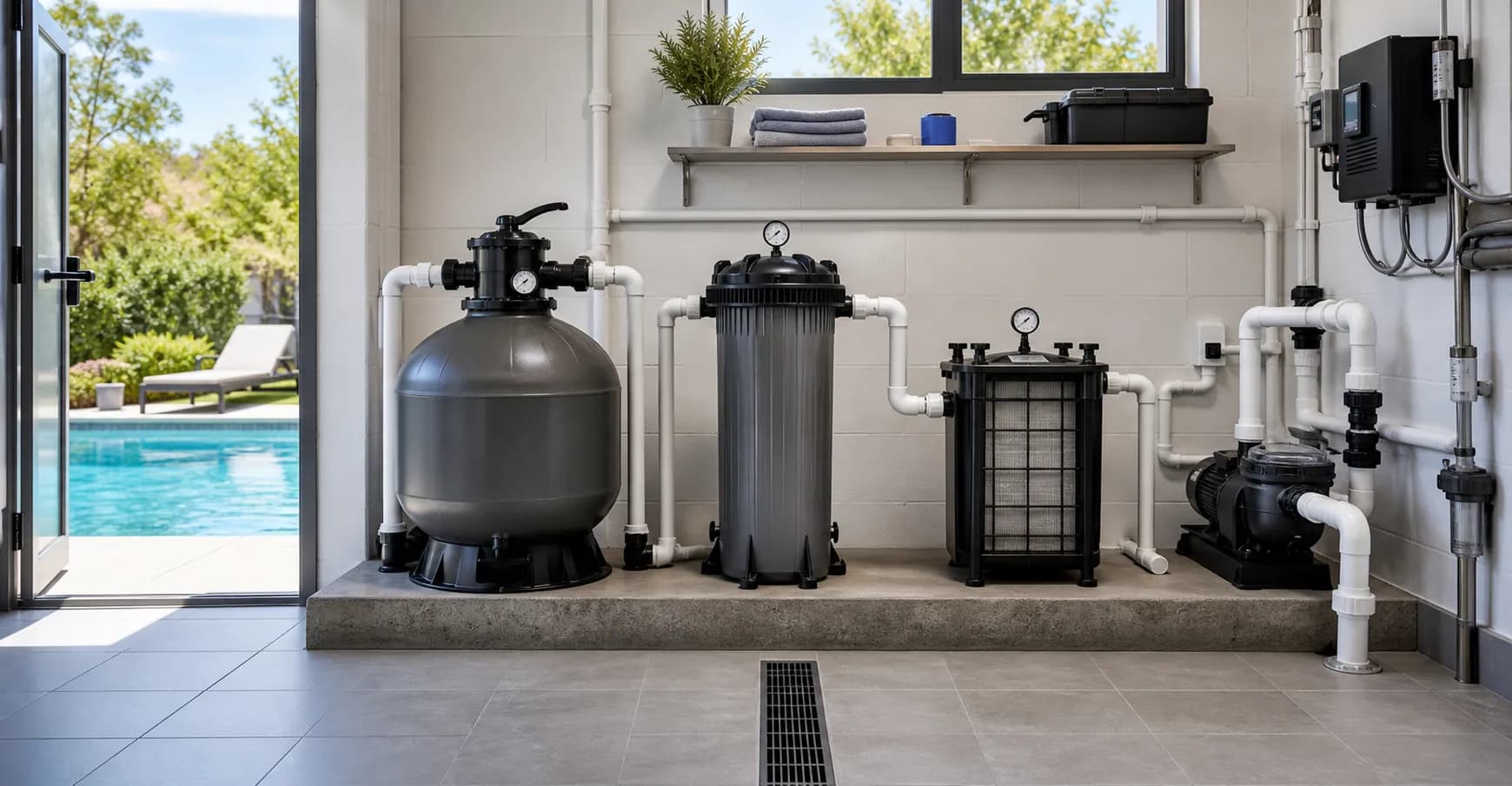
Cartridge and sand filters differ in more than how they trap particles. Cleaning frequency, water use, space and dirty-water disposal also vary. Whichever you choose, check that it accepts the pump's actual flow and has enough filtration area for the pool and its use.
Written and edited by: Pool Explained editorial team

How cartridge and sand filters work
Water passes through a pleated cartridge, with dirt trapped over its large surface area. Remove and rinse the element when dirty. This compact system needs no backwash drain and often suits smaller pools or locations where water conservation matters. Maintenance does, however, involve removing the cartridge and carefully washing it by hand.
A sand filter passes water through a tank containing suitable filter media. When dirt accumulates, reverse the flow and discharge it to waste. Cleaning is quick and convenient for larger pools, but uses water and needs proper drainage. Move the multiport valve only with the pump switched off.
Diatomaceous earth filters and glass or other media for compatible sand filters are also available. They can have specific advantages, but require correct use and are not automatically better for every household. Begin by understanding the practical differences between a good cartridge filter and a correctly sized sand system.
What size pool filter do you need?
Do not choose solely from a pool-volume label. Check filtration area, permitted flow and media quantity alongside actual pump flow. An undersized filter gets dirty quickly, restricts flow and needs frequent cleaning. A suitably larger filter can usually go longer between cleans.
Match pump and filter. Excess flow through a small filter may exceed its permitted filtration rate. Insufficient flow slows surface skimming and may prevent connected equipment from working correctly. The pump label alone is not enough, because pipework, valves and dirt reduce flow in operation.
Consider the real debris load. Trees, unpaved access and busy roads add more leaves and dust than a sheltered, tidy garden. Heavy use, sunscreen and seasonal opening can dirty the filter faster too. More filtration area under those conditions usually means less frequent cleaning and more consistent flow.
When to clean the filter
Record gauge pressure when the system is new or freshly cleaned. Use it as your baseline. Rising pressure with weaker return flow usually means accumulated dirt is increasing resistance. Follow the manufacturer's cleaning threshold rather than backwashing every day out of habit.
For a cartridge, first switch off the pump and fully release pressure. Rinse gently between the pleats without an attachment that could damage them. Greasy deposits may need a manufacturer-approved cleaner. Replace a cartridge that is torn, distorted or no longer comes clean.
For a sand filter, follow the valve sequence and instructions for that model. Backwashing is usually followed by a short rinse to resettle the media before normal filtration. If pressure rises again quickly, do not repeat endlessly: check water condition, algae load, flow and the media itself.
What a filter can and cannot remove
Clear water is not necessarily safe water. Filtration removes particles; disinfection controls microorganisms. If pH and chlorine are outside suitable ranges, longer pump operation alone will not correct them. Equally, chemicals cannot remove all the sediment that fails to reach the filter because circulation is weak or the element blocked.
Empty skimmer and pump baskets before they become full. They trap coarse debris and reduce unnecessary loading of the filter. Occasionally check whether dirt returns through the jets. If it does, inspect the valve, seals, cartridge or sand filter internals rather than considering water chemistry alone.
Before buying, check the price and availability of cartridges, media, seals and valves. Leave enough room to open and service the filter without removing other pipes. Choose a sufficiently large filter that you can clean properly and regularly.
What to check before buying a filter
Ask for the exact model, filtration area, permitted flow and pressure, media type and quantity or cartridge reference. Check whether the gauge, valve, connections and base are included. Replacement element or valve costs can substantially change the overall expense, especially if parts must be imported.
Establish where sand-filter backwash water will go. Without proper drainage, a simple clean can leave mud beside the pool or cause problems next door. For a cartridge filter, check the clearance needed to open it and replacement-element availability. If cleaning is awkward, you are more likely to put it off.
At the end of the first season, review how often you cleaned the filter and how easy it was. Nearly daily cartridge washing or frequent backwashing with substantial water loss may indicate undersizing, heavy debris loading or a chemistry problem. Use those records to adjust maintenance or check sizing before the next season.
Never open the housing under pressure or repair cracked clamps, lids or tanks with improvised parts. A damaged pressure-filter component can be dangerous. For leaks, housing distortion or a suspected valve fault, switch off the pump, release pressure as instructed and contact a technician.
If buying used equipment, inspect the housing in daylight and confirm its model before connecting it. Age alone is not decisive, but impact damage, faded brittle plastic or unidentified replacement parts warrant caution. Savings do not justify using a pressure-vessel component whose condition cannot be confirmed.