Pool Explained
SR
Problems and solutions

Water and air

Why does my pool smell strongly of chlorine?

Properly treated water does not normally have a penetrating pool smell. A strong smell often indicates chlorine has reacted with contamination. Check the water, recent use and ventilation.

Leave the area immediately if coughing, wheezing, breathing difficulty or severe irritation develops. Get to fresh air and seek medical help for severe symptoms.
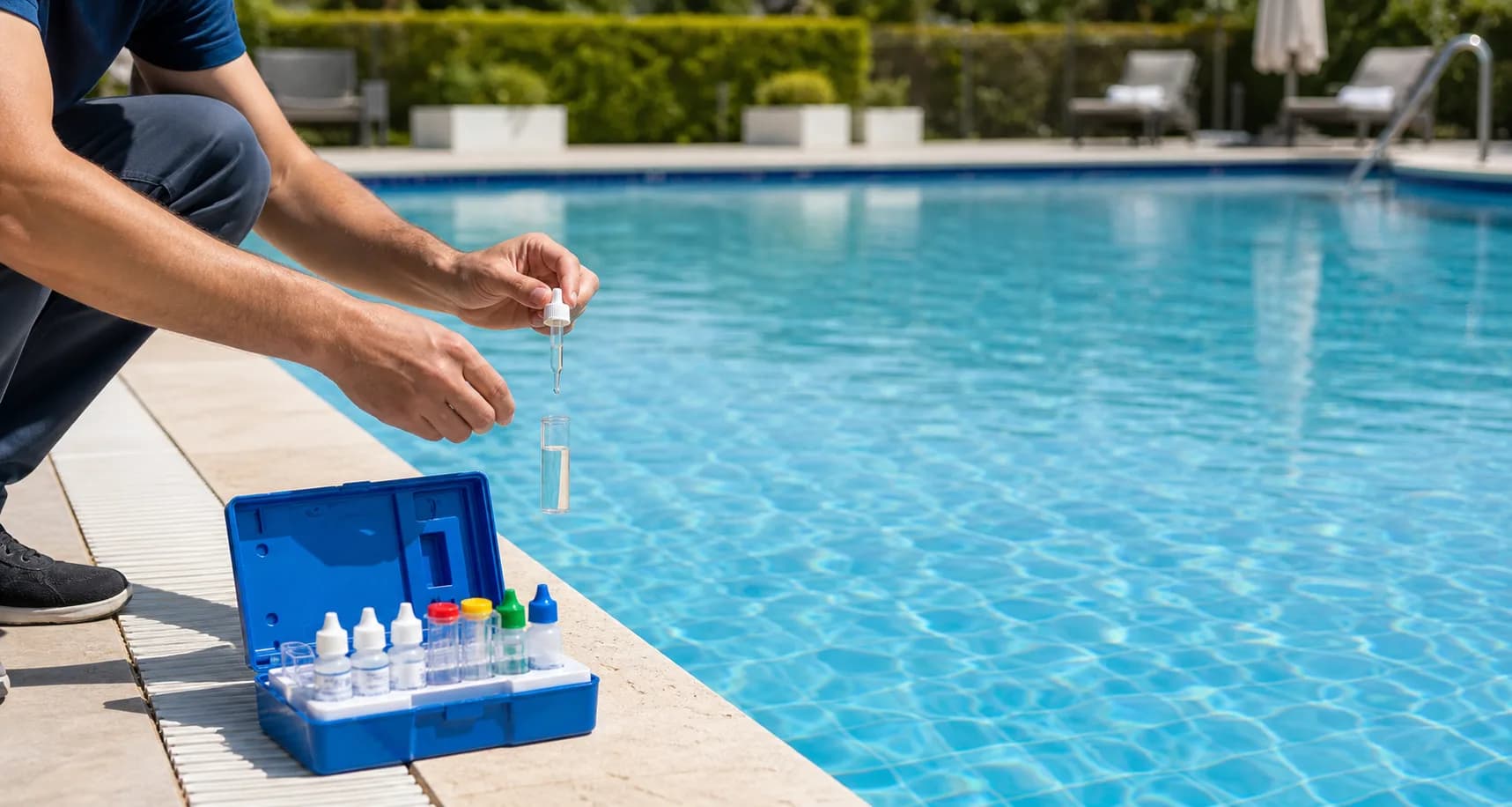
Testing water with a strong chlorine smell

Why does my pool smell strongly of chlorine?

A strong smell usually does not mean there is too much free chlorine. It is often caused by chloramines, which form when chlorine reacts with sweat, cosmetics and other organic contamination. Test the water before adding more chlorine.

Written and edited by: Pool Explained editorial team

1

You cannot judge chlorine levels by smell

Test pH, free chlorine and total chlorine. Subtract free chlorine from total chlorine to calculate combined chlorine. Take the sample away from a return jet and follow the test kit's instructions when reading it.

Wind can quickly disperse the smell around an outdoor pool. Indoors, it may linger just above the water. The strength of the smell is therefore not a reliable measure of water quality.

If the water is cloudy or bathers experience severe stinging eyes, coughing or difficulty breathing, stop swimming until the water and ventilation have been checked.

2

Check recent pool use, circulation and ventilation

A strong smell often appears after heavy use, a storm or several days of inadequate filtration. Note when the water was last tested, what was added and whether the pump or filter has been behaving differently.

Clean the baskets, check the return flow and compare filter pressure with its usual reading. If circulation is poor, adjusting the chemicals may provide only a short-lived improvement.

Indoor pools also need an adequate supply of fresh air and effective extraction from above the water. Ventilation removes polluted air, but it does not replace water treatment.

3

Choose the treatment from the test results

The right treatment depends on pH, free and combined chlorine, pool volume, stabiliser and the product you use. There is no single dose that suits every pool.

If an oxidising or shock treatment is needed, follow the product label, provide the specified circulation and keep everyone out for the stated waiting period. Never mix chemicals together.

After treatment, test the same readings again. Resume swimming only when the water is clear, there is no irritation and the results are back within the recommended ranges.

Initial signs

What to check when smell accompanies irritation or cloudiness

Smell and stinging eyes

Chloramines or unsuitable pH may be responsible; smell alone does not prove excess free chlorine. Stop swimming and test.

Strongest just above the water

Indoors, chloramines can pass into the air and accumulate where swimmers breathe. Both water treatment and fresh-air ventilation matter.

Appears after heavy use

Sweat, urine, cosmetics, skin cells and dirt consume free chlorine and form combined compounds.

A strong smell without test readings

Smell cannot distinguish free chlorine, chloramines and other chemical vapours. Start with DPD tests for free and total chlorine.

Troubleshooting

How to investigate a strong chlorine smell

Test first, then make only the adjustments supported by the results.

  1. 1Close the pool to swimming if users experience stinging eyes, coughing or breathing difficulty, visibility is poor or water conditions are unknown.
  2. 2For an indoor pool, provide fresh air and extract contaminated air above the surface. Dehumidification alone is not ventilation.
  3. 3Sample away from the returns. Measure free chlorine (FC), total chlorine (TC) and pH according to the test-kit instructions.
  4. 4Calculate combined chlorine: CC = TC − FC. A small difference within test uncertainty is not a confirmed problem.
  5. 5Check clarity, flow, the filter, skimmer, waterline and recent bather numbers. Remove visible organic debris.
  6. 6If CC is elevated, use the oxidation procedure specified by the manufacturer or a qualified professional. Keep the pool closed and well ventilated.
  7. 7Maintain circulation for the required time, clean the filter when needed and retest FC, TC and pH before reopening.

Test results

Understanding free, total and combined chlorine

Free chlorine (FC)

Chlorine available for disinfection. The appropriate level depends on the system, pH, stabiliser and local requirements.

Total chlorine (TC)

The sum of free and combined chlorine. TC alone does not show how much free disinfectant is available.

Combined chlorine (CC)

Calculated as TC − FC. CDC guidance for public facilities calls for action above approximately 0.4 mg/L combined chlorine. For domestic pools, follow product instructions and applicable local guidance.

pH and CYA

pH affects chlorine performance and swimmer comfort; cyanuric acid changes chlorine behaviour. Interpret FC alongside the other readings.

Common mistakes

Actions that increase the risk

Adding chlorine without testing

A reliable dose needs FC, TC, pH, water volume and the product specification. Very high chlorine can bleach a DPD test and produce a falsely low reading.

Mixing products

Never mix chlorine, acid or other chemicals in a container or through the same dosing line. Add separately with the required circulation and exactly as instructed.

Relying on ventilation alone

Ventilation reduces exposure but does not remove the source in the water. Correct treatment and reducing contamination are also necessary.

Swimming despite irritation

Irritation is not a normal sign of clean water. Leave the area for fresh air and seek medical help for severe symptoms.

Using a universal shock-dose formula

Treatment depends on measured combined chlorine, water volume and the product. Do not copy a dose calculated for another pool.

Ignoring swimmer hygiene

Pre-swim showers, toilet breaks and staying out with diarrhoea reduce the contaminants that form chloramines.

Prevention

How to reduce chloramine formation

Take a one-minute shower

A brief shower before swimming removes much of the sweat, cosmetics and dirt before they enter the pool.

Test more often during heavy use

During hot weather, gatherings and frequent swimming, test more often and record FC, TC, pH and bather numbers.

Provide effective ventilation

At indoor pools, fresh air should pass across the water towards extraction rather than recirculating chloramines into the breathing zone.

Clean regularly

Remove dirt from baskets, filters, overflow channels and the waterline so organic material does not remain in the system.

FAQ

Chlorine-smell questions answered

Does a strong smell mean too much chlorine?

Not necessarily. The familiar pool smell often comes from chloramines formed when chlorine reacts with sweat, urine, dirt and other substances. FC and TC tests distinguish free from combined chlorine.

How do I calculate combined chlorine?

Subtract free chlorine from total chlorine: CC = TC − FC. Use a reliable DPD kit and account for its resolution and reagent expiry dates.

Will shock treatment help?

It may if justified by testing and carried out correctly, but it is not an automatic first step. Keep swimmers out, ventilate well and follow a treatment procedure appropriate to CC, volume and the product’s active ingredient.

Why is the smell stronger indoors?

Chloramines can move from water into the air. Without enough fresh air and effective extraction, they accumulate above the surface, especially when swimmers or jets disturb the water.

When is it safe to get back in?

Only when water is clear, irritation has stopped, ventilation works and repeat tests meet product and local requirements. Observe the manufacturer’s waiting period after treatment.