Galvanised steel panels
Factory-formed sections are bolted together and supported as designed. Metal protection, cut edges, joints, penetrations and ground conditions all affect durability.
Modular in-ground construction
Factory-made panels form the walls, but a reliable pool also needs a suitable base, bracing, drainage, controlled backfill and a correctly fitted liner or membrane.
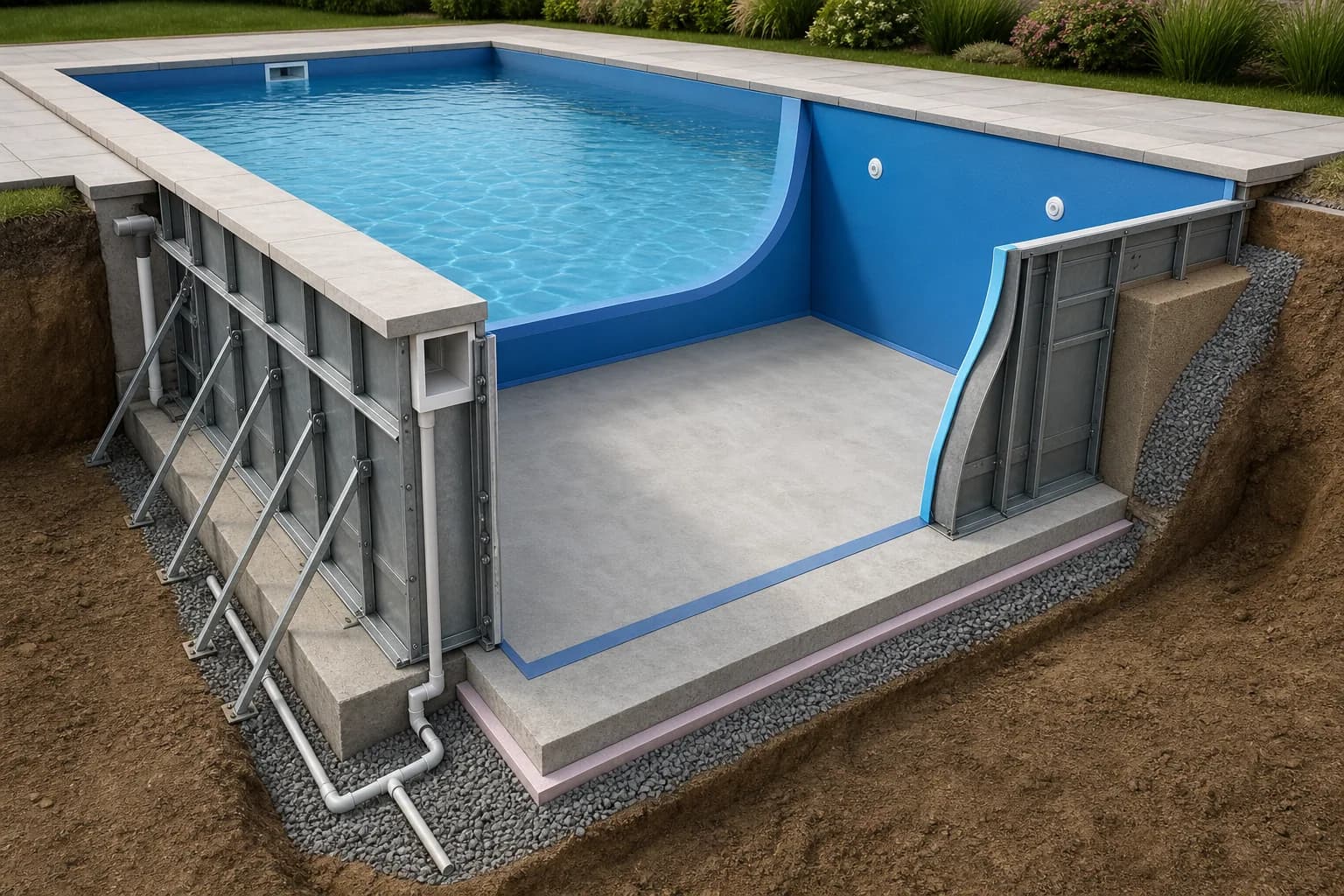
Water - internal pressure
Liner - watertight lining
Protective layer - smooth, clean base
Panel - modular structural wall
Support and backfill - external stability
Drainage - water control around the shell
This illustrates the relationship between layers, not a universal construction detail.
Definition and types
Panel describes the pool structure. Factory-made sections form the walls, the floor is designed separately, and a factory-made liner or reinforced PVC membrane usually retains the water. Panel and liner are therefore not synonyms.
Factory-formed sections are bolted together and supported as designed. Metal protection, cut edges, joints, penetrations and ground conditions all affect durability.
Non-metallic modular walls do not rust like steel, but still have structural limits. Use compatible joints, supports, backfill and the system's specified details.
This can describe different fibre-reinforced or multilayer materials. Load capacity and installation requirements must be established from the actual product documentation, not the general name.
Panel walls can be combined with a concrete floor, prefabricated steps and a liner or reinforced membrane. Clearly assign responsibility where products from different manufacturers meet.
Parts of the system
Panels are only one part of the pool. The quote should also cover ground preparation, foundations, services, lining, backfill, drainage and finished paving.
Panels form the pool shape and transfer lateral loads through joints and bracing.
Keep walls in position while supports are concreted and the pool is filled and backfilled.
It must be stable, level and compatible with the membrane underlay.
Felt or a specified underlay protects the liner and softens minor irregularities, but cannot correct a defective slab.
This retains the water. It is separate from the supporting panels, with its own warranty and service life.
These details keep rainwater away from walls, protect the top edge and provide safe access.
Check the site first
A panel wall is designed as part of a specific system. If its base, lateral support or drainage differs from the design, it may not perform as intended.
Undisturbed soil, fill, clay and unstable slopes behave differently. Design the floor, foundations and backfill for actual conditions, not a typical illustration.
External water can press on the shell when the pool level is low. Design drainage and uplift protection for the site; a pump in a sump is not a universal solution.
Panels can be carried in separately, making delivery easier than a one-piece shell on restricted sites. You still need safe access for excavation, concrete, backfill and equipment.
Grade paving and surrounding ground to drain rain away. Water behind panels can wash out material, increase pressure and undermine support.
During construction, a panel may have water on one side, fresh backfill on the other or incomplete support. Follow the system instructions for the order of filling, backfilling and support concreting.
Removing water removes internal pressure while soil and groundwater remain outside. Unplanned draining can displace the liner, deform a wall or cause foundation problems.
Installation stages
This is not a DIY construction manual. The system manufacturer, designer and qualified installer specify dimensions, materials, bracing and sequence.
Quality checks
Check system specifications, panels and coatings after transport, base levels, diagonals, drainage and bracing layout.
Ask for test records and photos of every joint and route. Keep valves, service joints and maintenance points accessible.
Surfaces should be clean, dry, smooth and free of sharp edges. Inspect corners, tracks, steps and fitting gaskets.
Watch wrinkles, liner position, wall shape, water level and coordinated backfilling. Mistakes are still visible at this stage and often correctable.
Use and upkeep
Unbalanced water can affect the liner, metal parts, seals and equipment. Test and dose according to volume and documentation, not appearance.
Do not drain routinely. Outside soil or water pressure and loss of internal water support can damage walls or lining. Draining needs a professional plan.
The lining may need replacing during the pool's life. Replacement is easier when tracks are accessible, dimensions recorded, fittings standard and service space unobstructed.
Do not wait until next season if you notice cracks, settlement, water behind walls, corrosion or distortion. Small changes are usually easier to investigate and correct.
Problems and solutions
Record the water level, weather and affected location, check the warranty and contact the installer. Opening up the lining before diagnosis can cause more damage.
Water behind the liner, chemistry changes, movement or poor fitting can cause wrinkles. Do not puncture or heat it at random. Check groundwater conditions and contact the installer.
Find the moisture source and damaged protection, especially around joints, penetrations and cut edges. Coating over an active problem without access and drying is not a reliable repair.
Stop draining or other work and secure the area. Unequal pressures, inadequate support or groundwater may be involved. Have a structural professional assess it.
First distinguish evaporation from leakage. Then investigate equipment, pipes, fittings and lining with methods that do not cause more damage. Random digging adds expense.
Do not rigidly support paving on panels unless the system permits it. Settlement often involves backfill, washout or drainage. Resolve the water problem before repairs.
Small local damage can sometimes be patched using an approved method. Larger areas, brittleness or multiple defects call for inspection of the whole lining and the underlying cause.
Costs
Panels are only one item. Include design, excavation and soil removal, foundations and concrete, services, lining, backfill, drainage, paving, equipment, electrics, safety measures and commissioning.
Shape, wall height, steps and custom details affect labour, lining and the number of joints. Request prices for the same scope and warranties.
A liner is a replaceable finish whose life depends on material, sunlight, water and maintenance. Allow for eventual replacement in your long-term budget.
Drainage, groundwater, restricted access and fill can cost more than the price difference between panel systems. Compare quotes only when they include the necessary site work.
Reviewing the quote
‘We always do it this way’ is no substitute for the system documentation, a site drawing and a clear division of responsibilities.
FAQ
No. Panels describe the supporting wall structure; a liner describes the watertight finish. They often go together, but liners can cover other structures. Assess the panel system independently of the lining.
Steel needs suitable corrosion protection. Polymer does not rust like steel, but still needs correctly designed bracing and connections that account for temperature changes. Compare documented systems and local service support.
It depends on the system, soil and design. Some use a full reinforced concrete slab; others use a specified cement-based or alternative floor. Ask the responsible designer to choose the site-specific solution from the technical documentation.
Wall assembly can be quick, but the complete job includes excavation, base preparation, services, lining, controlled filling and backfill, paving and safety measures. A timeframe without a defined scope is not useful.
Modular panels allow various shapes, but radii, heights, steps and corners must be supported by the system. Non-standard combinations add joints and need specific lining design.
It is generally designed to be replaceable. How straightforward the job is depends on track access, substrate condition, fittings and the availability of compatible lining.
Only with a designed solution for drainage, external pressure and draining procedures. The panel material alone does not solve groundwater problems.
Panels can reduce wet construction work and speed up accurate wall assembly. Concrete allows more custom shapes and finishes. Installer quality, ground conditions, lining and complete cost matter more than the system name.
Related guides
Choosing, welding, caring for and eventually replacing a PVC liner.
Learn moreCompare modular walls with a continuous reinforced-concrete shell.
Learn moreCheck ground conditions, groundwater, access and drainage before requesting a quote.
Learn moreCompare quotes for the same scope of work.
Learn more