Two connected wall surfaces
The inner and outer surfaces are made of fabric coated with PVC or a similar material. An air chamber lies between them, with seams connecting the walls to the pool floor.
Inflatable pools with rigid walls
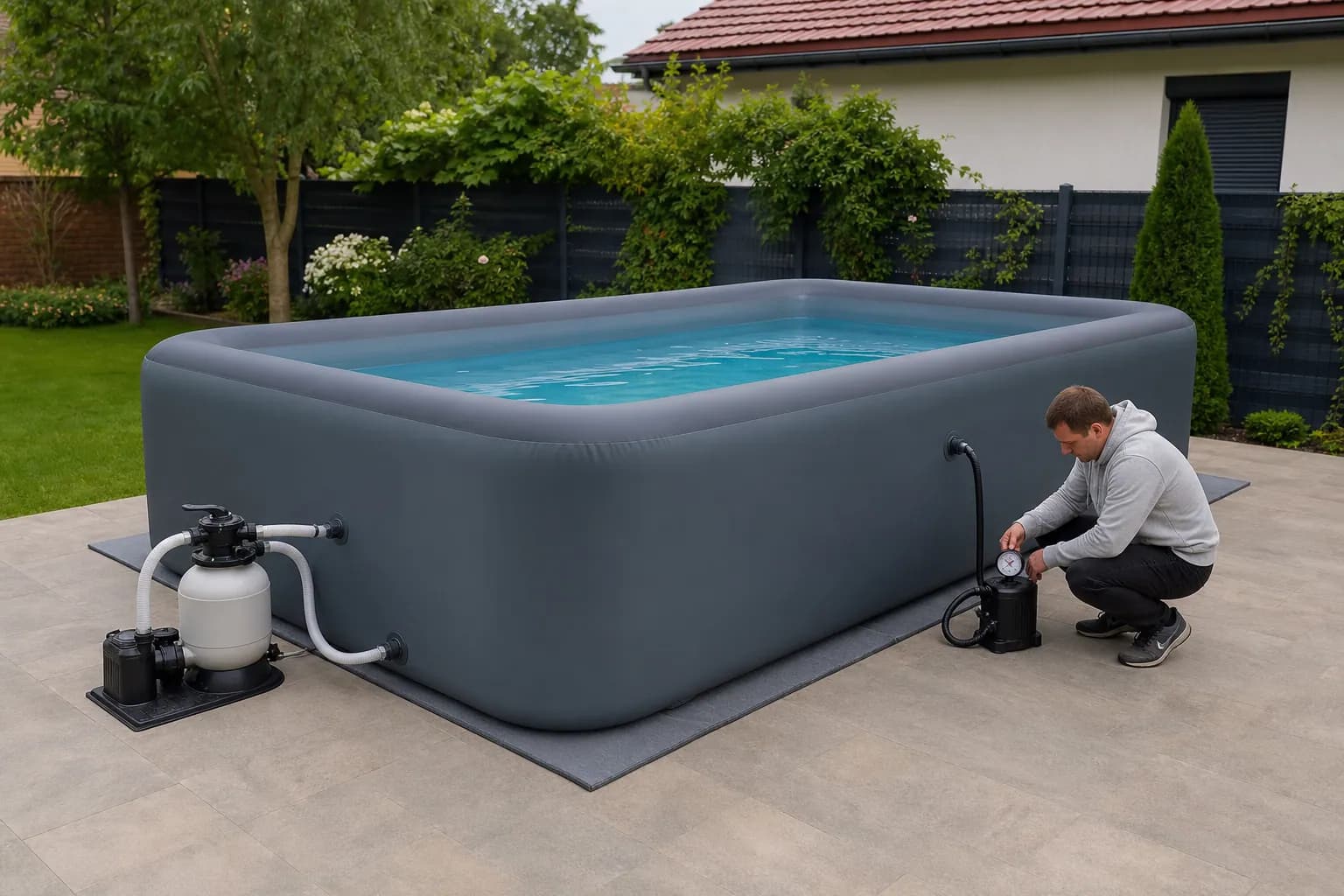
A DWF pool has flat, rigid inflatable walls without a metal frame. It needs less surrounding space than a similarly sized frame pool and can be packed away after summer. It usually costs more, so check operating pressure, warranty and repair support before buying.
Construction
An ordinary air chamber rounds out when inflated. In a DWF wall, internal threads join the two faces and keep them flat.
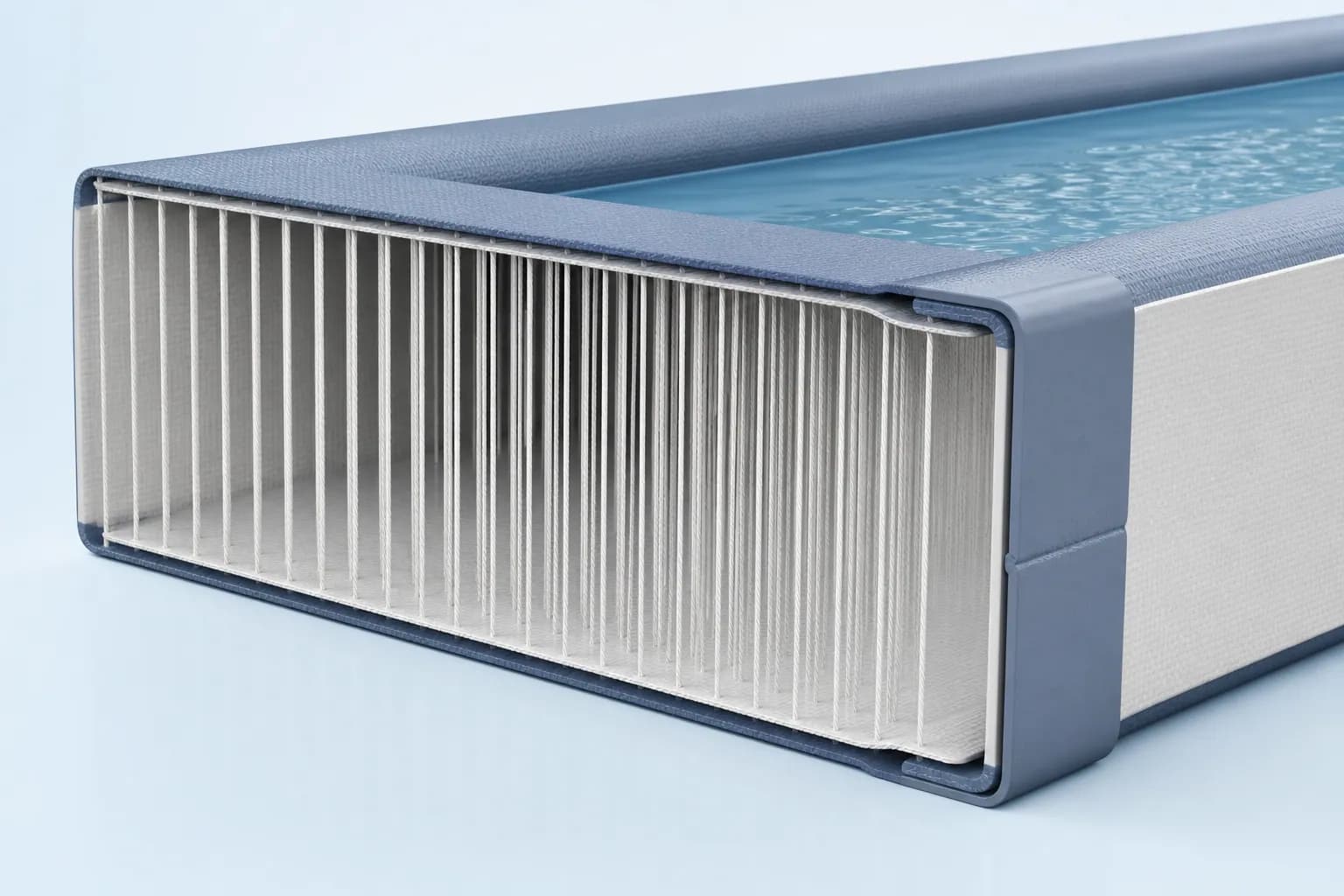
Two connected wall surfaces
The inner and outer surfaces are made of fabric coated with PVC or a similar material. An air chamber lies between them, with seams connecting the walls to the pool floor.
Internal threads keep the wall flat
Thousands of short polyester threads connect the two sides. Once inflated, these threads limit how far the surfaces can separate, keeping the wall flat rather than balloon-shaped.
Inflation to a specified pressure
A DWF wall uses higher pressure than a conventional inflatable-ring pool, making it much firmer. The permitted pressure varies by model: always check the manufacturer's instructions.
Sellers do not always explain the abbreviation DWF in the same way. The term drop-stitch describes the internal-thread construction more precisely. Do not choose on the label alone: check materials, operating pressure, temperature limits and warranty terms in the technical specifications.
Advantages
The main differences are appearance, clearance around the walls and end-of-season storage.
No external metal frame
The walls hold their shape without external legs or crossbars. This gives a tidier appearance and can make the pool easier to fit into a small garden.
No metal frame to assemble
Once the base is ready, unfold the pool, inflate it to the specified pressure, connect filtration and fill gradually. Large models are still heavy and easier to install with several helpers.
Seasonal storage
An emptied and correctly folded DWF pool takes up less storage space than a frame structure. Larger models remain heavy and usually need several people to move them.
No metal top rail
The flat wall has no metal tube along its top. That does not make it a seat or platform: sitting, standing or jumping on it can damage the material and seams.
Limitations
The higher price is not the only difference. Check repair options, parts availability and installation and storage instructions for the exact model.
Installation
Before filling, check that the base is level, firm and clear of debris. Inflate the walls to the pressure stated in the model's manual.
1. Read the manufacturer's requirements
Find the pressure limit, temperature range, inflation sequence, base requirements and equipment connection instructions. Specifications for another drop-stitch product may not apply to your pool.
2. Prepare a firm, level base
Remove stones, roots and anything that could puncture or rub against the floor. The ground must be level and strong enough not to settle unevenly under the water's weight.
3. Unfold without dragging
Lay the material on a clean protective groundsheet and do not drag it over concrete. Before inflation, position the valve, filtration connections and drain where you need them.
4. Inflate using a pressure gauge
Use a pump and adapter suitable for the valve. Increase pressure gradually, check wall shape and stop at the manufacturer's specified reading.
5. Fill gradually
After the first few centimetres, check that the floor lies flat and water does not collect on one side. If there is a noticeable slope, drain the pool and correct the base. Never lift or pack underneath a pool containing water.
A smooth base is not necessarily level.
A concrete slab can have no bumps and still slope. Soil can look level yet settle unevenly under water weight. Check levels and bearing capacity, and plan where rainwater and drained pool water will go.
Air pressure
Use the value marked on the pool or in its manual. Check with a gauge: firmness to the touch is not a reliable measurement.
Use the pressure for your exact model
Some manufacturers specify around 0.7–0.9 bar for particular DWF pools, but this is not a general recommendation. Valves, panel thickness, seams and construction differ between models.
Pressure increases as the wall air warms
Air expands when heated. A pool inflated on a cold morning may become much firmer in strong sunlight. Check pressure under the conditions specified in the manual.
A softer wall does not always mean a leak
Pressure can fall temporarily after a cold night. If the wall keeps softening at a steady temperature, inspect the valve, cap, surfaces and accessible seams using the manufacturer's procedure.
Record pressure after correct installation and check again after significant temperature changes. Add or release air only using the procedure specified for the model.
Equipment
Read the exact kit contents before buying. Add any missing filter, gauge, ladder or special connectors to the total cost.
Water circulation pump and filter
Size the circulation pump and filter for pool volume and required flow. The separate air pump used to inflate the walls does not circulate pool water.
Learn moreA correctly sized ladder
The ladder must stand securely and suit both wall height and user weight. Its platform and supports must not transfer weight onto a DWF panel.
Groundsheet and cover
A groundsheet protects against abrasion but cannot fix poor ground preparation. A cover reduces debris and heat loss; an ordinary solar cover does not protect against falling into the water.
Learn morePressure gauge and repair supplies
Check whether a suitable gauge, adapter, patches and valve tool are included. Confirm that replacement valves and connectors will remain available.
During the season
Test and filter the water as you would in another above-ground pool. Also check wall pressure, valves, seams and outside surfaces periodically.
Test the water regularly
Measure pH and disinfectant, clean surfaces and act before water turns cloudy or green. Dose according to the chemical label and never leave concentrated product on PVC surfaces.
Maintain filter flow
Clean the pump basket and filter, check return flow, and adjust filtration hours for swimmer numbers, water temperature and debris.
Inspect walls and seams
Check the valve, seams and wall surfaces periodically. Investigate dampness, scratches or changing wall shape before damage worsens.
Check pressure after temperature changes
Do not automatically add air every day. Follow the pressure-checking instructions, particularly after a large temperature change or if a wall stays soft during the warmer part of the day.
Use chemicals according to both their labels and the pool manual. Never mix products, and do not leave granules or other concentrated chemicals on PVC surfaces: they can discolour or damage the material.
Comparison
DWF has no external legs and generally looks tidier, but costs more and comes in fewer sizes. Metal-frame pools are usually more affordable, with easier access to parts and accessories.
Consider DWF when space around the pool is limited
Without projecting frame legs, it may fit a narrower part of the garden. Still check the complete outside dimensions, kit price and repair support.
Consider a metal frame for a lower budget and more size options
There are generally more sizes and lower-priced kits to choose from. Allow for the space taken up by legs outside the pool wall.
Buying a pool
Two models with similar outside dimensions can differ in bathing space, equipment, warranty and repair options.
Actual internal dimensions
Outside length and width do not show how much bathing space you get. Check internal dimensions, fill height and water volume.
What the kit includes
Check whether the price includes an inflation pump, gauge, filter, hoses, ladder, groundsheet, cover, patches and delivery.
Repairs and spare parts
Ask who handles valve or seam repairs and how long matching connectors, adapters and other original parts will be available.
Warranty terms
Check coverage for walls, seams, valves and accessories, and how the manufacturer defines an unsuitable base or incorrect inflation pressure.
End of the season
Fold the pool only when it is completely clean and dry. Moisture in folds, frost, excessive heat and rodents can damage it in storage.
Drain without undermining the base
Disconnect electrical equipment and direct water to an approved discharge point. A large release can damage the base, plants or neighbouring property.
Clean and dry the material thoroughly
Use a mild cleaner approved for the surface. Dry seams, valves, the floor and folded areas particularly carefully.
Fold without sharp creases
Release air gradually and follow the folding instructions. Store dry, away from frost, excessive heat, chemicals, sharp objects and rodents.
Common mistakes
Uneven bases, incorrect pressure, loads on the walls and folding damp material cause many problems.
Safety
A DWF pool carries real drowning, fall and electrical risks. Rigid walls or a removed ladder cannot replace supervision and properly controlled access.
Supervise children closely
The adult supervising must not use a phone, read or leave the pool area. Barriers and appropriate covers provide additional protection, not a substitute for supervision.
Control access with a physical barrier
Use fencing or another suitable barrier that meets local requirements. Secure or remove the ladder when the pool is unused, and keep climbable objects away from the walls.
Connect electrical equipment safely
Use pool-rated equipment and the electrical protection required for wet locations. An extension lead beside the water is not a permanent solution; have a qualified electrician check any uncertainty.
FAQ
DWF usually describes the multilayer fabric used to make a rigid inflatable wall. The important construction feature is drop-stitch: thousands of internal threads connect the two faces and prevent the chamber from ballooning.
No. A conventional air chamber stays softer and rounded, while a drop-stitch wall can operate at higher pressure and hold a flat, much firmer shape. Both still rely on intact material, valves and correct pressure.
Only the pressure specified for your exact model. There is no safe universal pressure for all DWF pools. Do not use a figure from a paddleboard, another pool or a general sales listing.
Only if the ground beneath is level, firm, cleared and prepared as the manual requires. Grass cannot correct a slope, soft soil, stones or roots.
Most models are designed to stand freely above ground. Do not backfill or partly bury one unless the manufacturer expressly permits it and provides detailed installation instructions.
Only if the model documentation permits it. Portable DWF pools are generally drained, cleaned, fully dried and stored indoors away from frost, excessive heat and rodents.
A small puncture on an accessible flat area can often be patched with the manufacturer's recommended kit. Seam separation, a faulty valve or broken internal threads need a different assessment and often professional repair.
Consider DWF for a neat appearance without external framing and compact seasonal storage. Metal-frame pools are usually cheaper, offer more sizes and have more readily available parts. Compare complete prices, base requirements and repair support, not appearance alone.