
How to choose a robotic cleaner for your pool
A robotic cleaner makes sense when you want regular cleaning without guiding a vacuum by hand. Before buying, check pool dimensions, shape and surface, whether you need wall and waterline cleaning, the robot's filters and servicing availability.
Written and edited by: Pool Explained editorial team
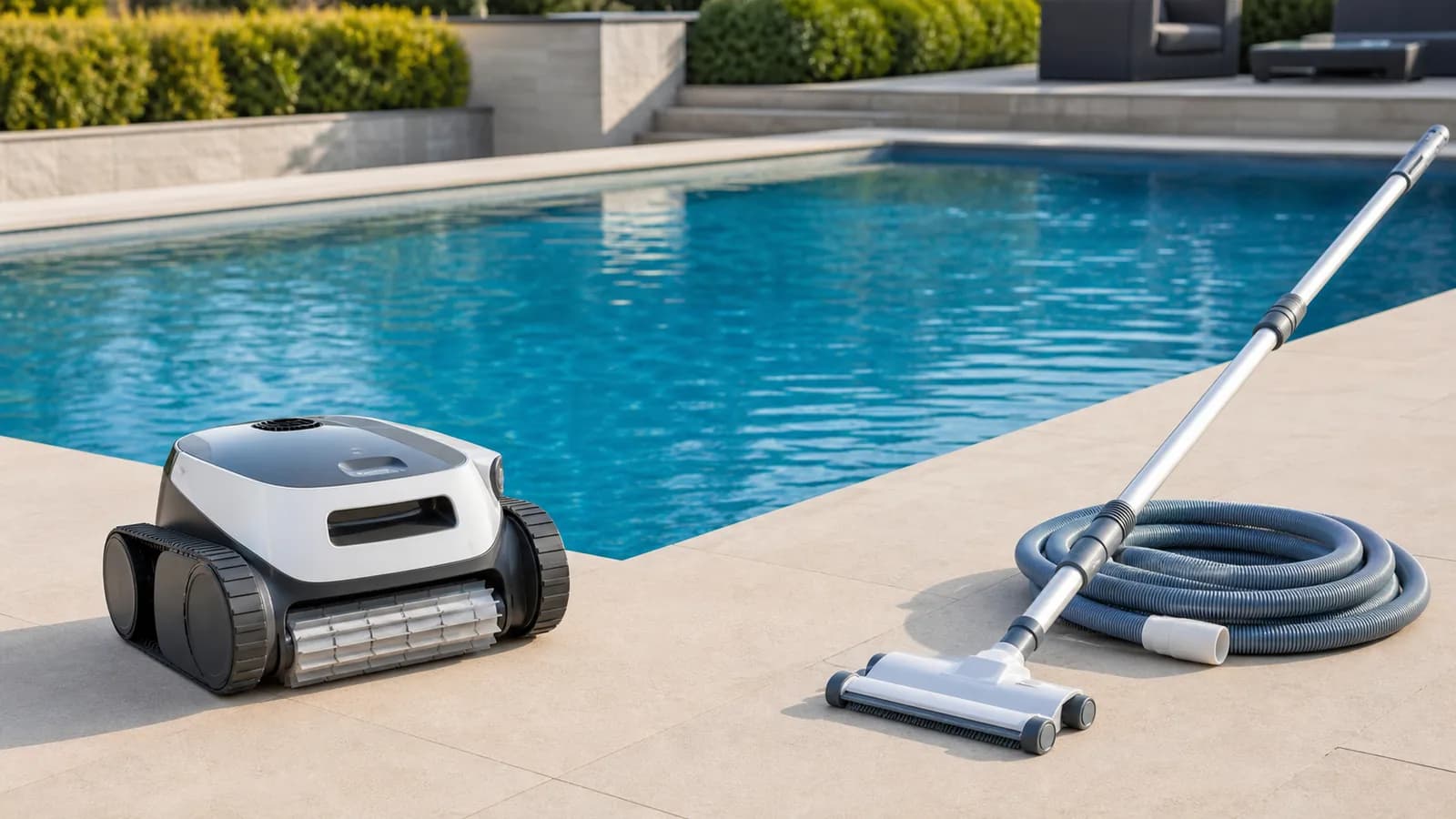
First check which type of cleaner you are considering
A self-contained electric robot has its own drive, brushes, pump and filter. It does not rely on the main pool pump's suction and collects debris in its own basket or filter panels. An automatic suction cleaner connects to the skimmer or a dedicated suction line and uses the pool's existing pump and filter. Both can clean the floor, but operate differently and place different demands on the system.
A pressure-side cleaner uses return water and sometimes a booster pump. It is most practical when the installation is already set up for it. If you want cleaning without changing valve positions, occupying the skimmer or sending all the debris to the main filter, look for a self-contained electric robot. Check the technical description: sellers sometimes use robot to describe simpler automatic cleaners too.
Floor, wall and waterline cleaning are separate features
Almost every robot cleans the floor, but not every model climbs walls. A wall-climbing model may not clean along the waterline, where grease, sunscreen and scale accumulate. If you need all three surfaces cleaned, check that the exact model lists them. Do not rely on a photograph of a robot on a wall or a general description of the range.
Steps, benches and shallow shelves are the hardest areas to clean. A robot may miss them because it is wider than the tread, there is insufficient water depth or it loses grip at the transition. For an irregular pool, choose a model intended for that shape. Ask the seller to confirm compatibility with the surface, floor slope and floor-to-wall transition.
Choose according to the surfaces it actually cleans, not the number of programmes in its app.
Choose filters for the debris in your pool
Large leaves and fine dust need different filters. A coarser basket handles leaves without blocking as quickly; a fine insert catches dust and pollen better but clogs sooner. Some models offer multiple layers or interchangeable panels. Check what is included, the cost of an extra fine filter and whether it is easy to wash without extensive dismantling.
After a storm leaves the pool full of twigs and leaves, use a net first. Do not expect the robot to collect all the garden debris. An overfilled basket reduces flow and performance, while fibres and twigs can jam brushes or the impeller. Robots suit everyday dust, grass and small leaves well. For heavy storm debris, removing the larger pieces by hand is quicker and safer for the cleaner.
Corded and cordless models have different advantages
A corded robot can run longer without waiting for a charge, which suits larger pools and lengthy cycles. It needs a safely positioned power supply, enough cable and storage without sharp bends. Never lift a robot out by its cable. Coiled excess cable can interfere with movement and wear more quickly.
A cordless model is easier to place in the water and has no cable across the deck. Check battery life in the programme you will use, charging time, retrieval method and replacement battery cost. Enough charge for a short floor cycle may not cover walls and the waterline in a large pool. Cordless is not automatically better: setup is simpler, but charging and battery condition need attention.
Check servicing and spare parts before buying
Brushes, tracks, filters, seals and batteries wear out. Before buying, find out who services the model in your country, how long the warranty lasts and whether basic spares are readily available during the season. Then compare apps, remote controls and scheduling. Those features are of little use if you cannot replace a filter or repair the drive.
Consider the robot's wet weight too. A unit that is easy to lower in may be awkward to retrieve when full of water and dirt. A caddy helps with transport and cable storage but needs its own space. If you must carry the robot up steps or through the house, try or at least check that part of handling before buying.
A robot cleans surfaces; you still need to treat the water
A robot does not replace the main pump, filter, disinfection or water testing. It can collect sediment and brush surfaces, but cannot correct low chlorine, unsuitable pH or weak circulation. For green or persistently cloudy water, test first, make the required adjustments and check filtration. Starting the robot immediately may only clog its filter while the cause remains.
After each cycle, empty and rinse the basket, remove hair and threads from the brushes and let the unit drain out of strong sunlight. At the end of the season, clean and dry it and store it protected from frost. Regular care reduces the likelihood of a breakdown in the middle of summer.
If you are unsure whether you need a robot, record floor-cleaning frequency, time spent and typical debris for two weeks. An expensive unit may not be worthwhile for ten minutes of manual cleaning once a week. If you keep postponing cleaning or it takes an entire afternoon, a robot could make a substantial difference. Keep timing maintenance afterwards to see how much time it really saves.
Before buying, check the surfaces it cleans, how you maintain it and where it can be serviced.