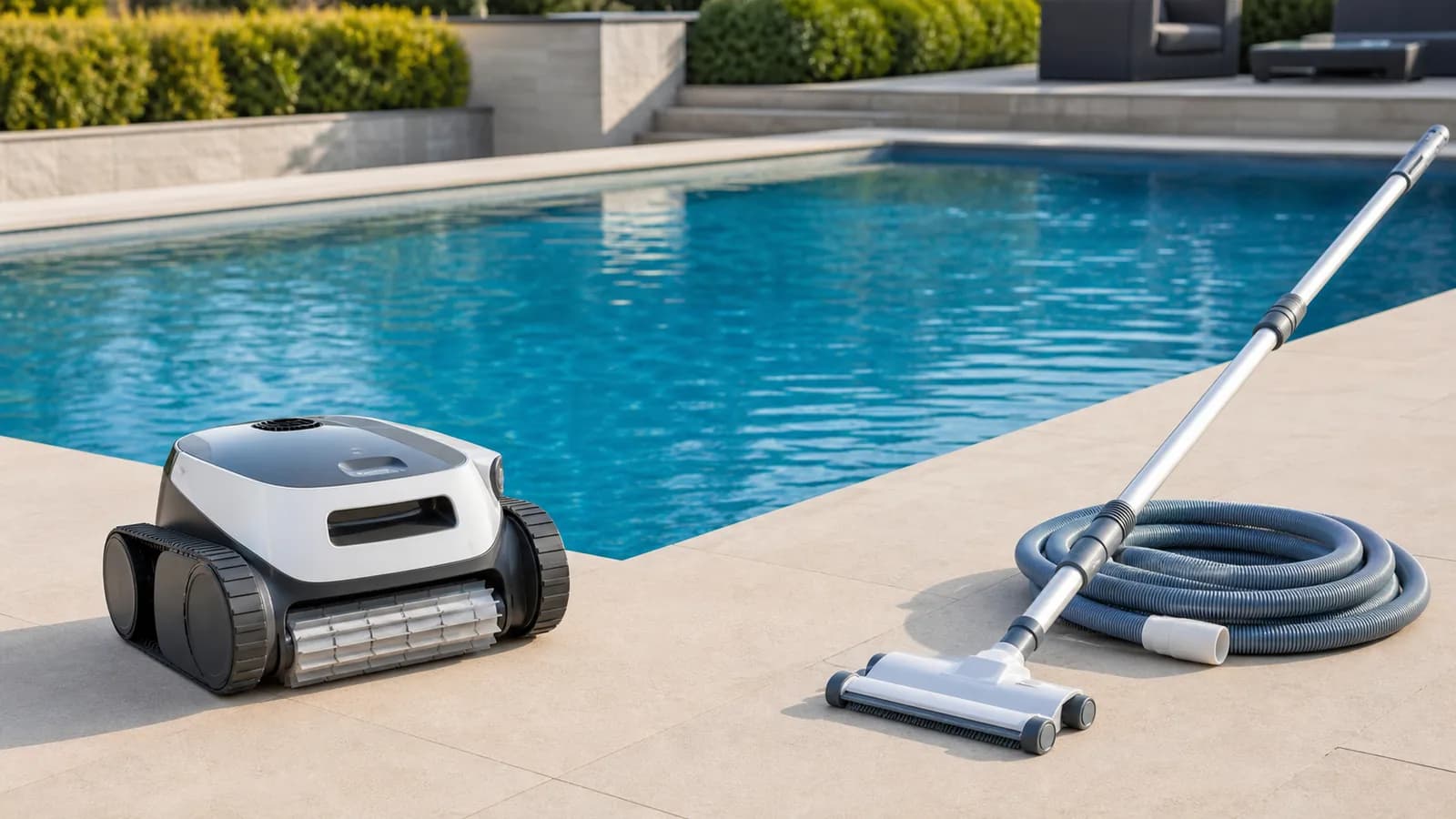
Should you use a robot or a manual pool vacuum?
A manual vacuum costs less and lets you clean precisely where needed. A robot costs more but can clean regularly without you standing beside the pool. A manual kit is often enough for a small, simple pool; a robot tends to be more useful for a larger or frequently used one.
Written and edited by: Pool Explained editorial team

What manual vacuuming involves
A conventional manual vacuum connects by hose to the skimmer or a dedicated vacuum point. The main pump draws dirt towards the filter while you slowly guide the head across the floor. You can see the deposits and make extra passes over particular spots. This is useful on steps, in corners and after a small spill of soil or sand.
Prepare the equipment before vacuuming. Fill the hose with water to avoid introducing air into the pump, set the valves correctly and check that the baskets and filter are clean. Afterwards, rinse the equipment and clean the filter if necessary. This is a short task in a small pool, but can take considerable time in a larger or heavily used one.
Why a robot is convenient for regular cleaning
A self-contained robot has its own drive and filter. Lower it into the water, select a cycle and empty the basket afterwards. It does not occupy the skimmer or send all the debris through the main filter. Its main advantage is not perfect coverage of every corner, but that you can run it several times a week without standing beside the pool.
Removing dust, grass and small leaves several times a week means less cleaning at the weekend. Higher-specification robots may brush walls and the waterline, but you will often still need to clean steps and narrow benches by hand. A robot reduces manual work; it does not remove the need for a net, brush and tools for awkward areas.
A robot is most worthwhile when used regularly, not just for an occasional major clean.
Compare purchase and running costs
A manual kit is inexpensive if you already have a suitable pump, filter, telescopic pole and vacuum connection. Ongoing costs include your time, water for any backwashing and additional use of the main filter. Vacuuming to waste also removes pool water that must be replaced and rebalanced.
A robot costs more upfront and needs replacement brushes, tracks, filters and, for cordless models, batteries over time. Repairs can be expensive too. However, its own filter retains the dirt, reducing debris reaching the main filter and your time handling a vacuum hose. Compare costs across several seasons, cleaning frequency and spare-part prices for the model you are considering.
Different tools suit dust, leaves and fine sediment
A robot is convenient for a light layer of dust and small debris. Remove large amounts of leaves with a net first, whichever vacuum you own. Vacuum fine sediment that lifts easily very slowly by hand. Sometimes it needs to go directly to waste, provided the system supports this and you can replace the lost water.
For deposits on walls, a robot with active brushes may help only if it is designed to clean walls. Vacuuming alone does not deal with algae: correct the water chemistry and allow filtration to remove the loosened particles. Neither type of vacuum replaces finding the cause when the same problem quickly returns.
A robot usually saves more time in a larger pool
Manually vacuuming a small, flat-bottomed above-ground pool may take only a few minutes. If it is used occasionally and few trees are nearby, a robot mainly adds convenience. Dirt builds up faster in a larger family pool used every day. Running a robot several times a week can then greatly reduce manual cleaning time.
Choose more carefully for irregular shapes, steps and benches. A manual vacuum can clean wherever you can physically reach. A robot's results depend on its dimensions, grip and navigation. Check compatibility with your pool's shape and surface. A maximum pool-length rating does not guarantee it will clean every step and shelf.
You may find both useful
Let the robot clean the floor during the week and keep a manual vacuum for steps, corners and specific deposits. You need not buy both immediately. Start with a manual kit and record cleaning frequency and time for a few weeks. If you keep putting it off because it takes too long, you have a clear reason to consider a robot.
If you choose one, decide whether purchase cost or the time spent vacuuming matters more. A manual vacuum is cheaper and gives precise control over a particular area. A robot can clean more frequently without you guiding it. Choose for your pool size and weekly routine, not for a better catalogue photograph.
Think about storage. A long hose, pole and vacuum head need a dry space or wall rack. A robot must drain after use and needs room for its cable, charger and possibly a caddy. Carrying everything through the house each time or leaving it in direct sun makes maintenance unnecessarily awkward.
Before buying, consider renting a robot or requesting a demonstration in a similarly shaped pool. Watch whether it handles the slope, gets stuck on a drain or climbs the wall. This is more informative than a video shot in a plain rectangular pool. Also check how easily the dirty basket empties and whether a fine filter is included.
A manual vacuum is a sensible starting point. A robot becomes a worthwhile purchase when regular manual cleaning takes too much time.