How to choose between a sand and cartridge filter
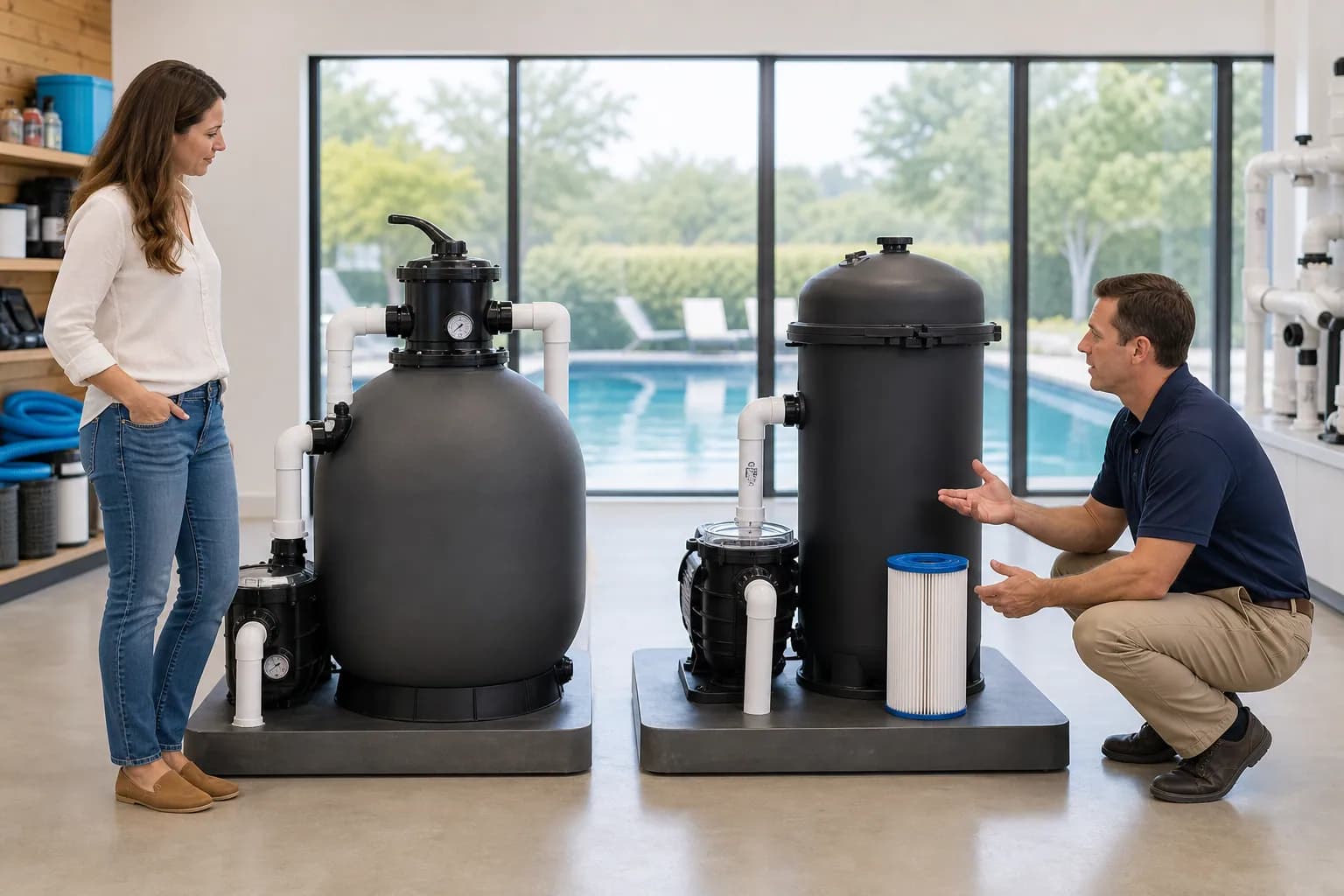
A cartridge filter is often more practical for a smaller pool or a property without a suitable backwash drain. If the pool collects plenty of dust, pollen and leaves and you can safely discharge backwash water, a sand filter is generally quicker to clean. Both can maintain clear water when correctly sized, matched to the pump and regularly maintained.
Written and edited by: Pool Explained editorial team
The main difference is how you clean them
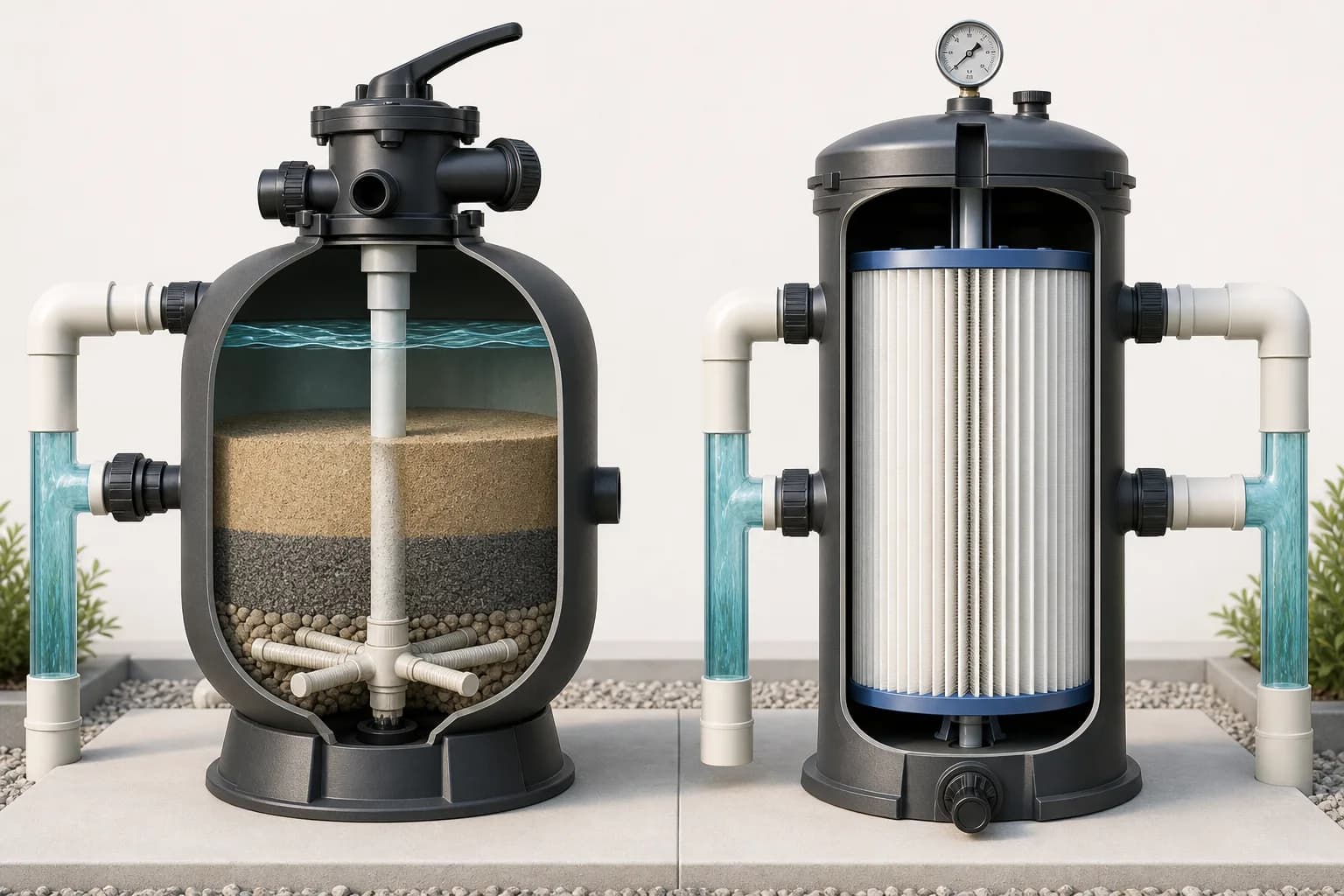
A sand filter is cleaned by backwashing. Switch off the pump, move the valve to the required position, then run water backwards through the sand to carry dirt to waste. It takes little time, but uses some pool water each time. Never move a multiport valve while the pump is running.
A cartridge filter is not backwashed. Switch off the pump, release pressure, open the housing and remove the cartridge for washing. You do not discharge pool water, but need more hands-on time and enough clearance to lift the element out.
Consider cleaning frequency and whether you have somewhere suitable to discharge backwash water.
Cartridge filters: less backwash water and a compact installation
A cartridge filter often has a smaller housing and needs neither a multiport valve nor a dedicated backwash pipe. This suits compact equipment areas and sites without somewhere to discharge larger volumes of water.
Cartridge filters are not just for small above-ground pools. A sufficiently large model can work well on a larger family pool too. Problems arise when an undersized cartridge is paired with a large pool and needs washing very frequently.
Rinse the cartridge gently according to the manufacturer's instructions. A powerful jet held close can damage the material. Keeping a spare cartridge lets you resume filtration while cleaning the removed one.
Sand filters: quick cleaning, but more water used
Sand filters are often chosen for medium and large pools because the media can be cleaned in minutes without opening the tank. This is convenient where dust, pollen, leaves and other debris arrive frequently. Backwashing is usually followed by a short rinse, following the valve markings and manufacturer's instructions.
Backwashing needs a suitable outlet. Do not discharge water where it floods the garden, undermines the pool or runs onto a neighbour's property.
Sand does not automatically need replacing every year. Replacement depends on its condition, pressure changes, filtration quality and manufacturer guidance. If sand appears in the pool, inspect the internal collector and assembly, but remember that brown sediment is not always filter sand.
An undersized filter causes problems whichever type you choose
When a small filter clogs quickly, pressure rises and flow falls. This can happen with either sand or cartridge filters if they are too small for the pool or pump. Check permitted flow, cartridge area or media quantity and the recommended pump range before buying.
Match the pump and filter. A more powerful pump does not fix an undersized filter and may push through more water than it can treat properly. If the water is not clear, check flow, pressure and operating time before changing filter type or adding more chemicals.
Particle size is not the only factor in clear water
Cartridge filters often capture finer particles than standard sand media. That does not mean every cartridge filter performs better. If undersized or blocked, it restricts flow and circulation through the pool suffers.
A correctly sized sand filter can maintain very clear water with good circulation and timely cleaning. A particle-size rating alone is not enough to judge the complete system.
A filter does not adjust pH or disinfect water. Clarifiers and flocculants are not suitable for every filter type either, so check the product label before use.
Which filter is right for you?
A cartridge filter is usually more practical if you have no backwash outlet, want to lose less pool water during cleaning and do not mind washing an element by hand. Sand is more convenient if debris enters frequently, the filter needs frequent cleaning and suitable drainage is available.
The surroundings affect cleaning frequency. A pool beside an unpaved road or under trees will dirty its filter faster than a covered pool on a clean terrace. A cartridge washed monthly in one garden might need weekly cleaning in another.
Ask the seller for the exact filter model, permitted flow, cartridge area or media quantity, spare-part prices and warranty conditions. Compare these with your pump and pipework.
At first startup, record the pressure with a clean filter. There is no single reading that means every filter is dirty. Decide when to clean from the pressure rise, weaker flow and manufacturer's instructions. If pressure behaves unusually, check the gauge itself before opening the filter.
Cartridge filters are not limited to small pools, and sand is not always better. Filter size, pump flow and maintenance arrangements matter most.