
Before paying a deposit, confirm that the pool fits the property, exactly what the price includes, who carries out each stage and who is responsible if something goes wrong. The quotation should specify equipment models and performance, earthworks, plumbing and electrical work, warranties, timescales and handover. The most common mistake is not choosing the wrong colour or shape, but accepting incomplete quotations that cannot be compared fairly.
Written and edited by: Pool Explained editorial team
Check what fits the site before requesting quotations
Before speaking to suppliers, write down who will use the pool and how. Swimming, children's games, relaxation and hydrotherapy need different dimensions, depths and equipment. Note the usual number of bathers, the season length you want and how much time you can spend on maintenance.
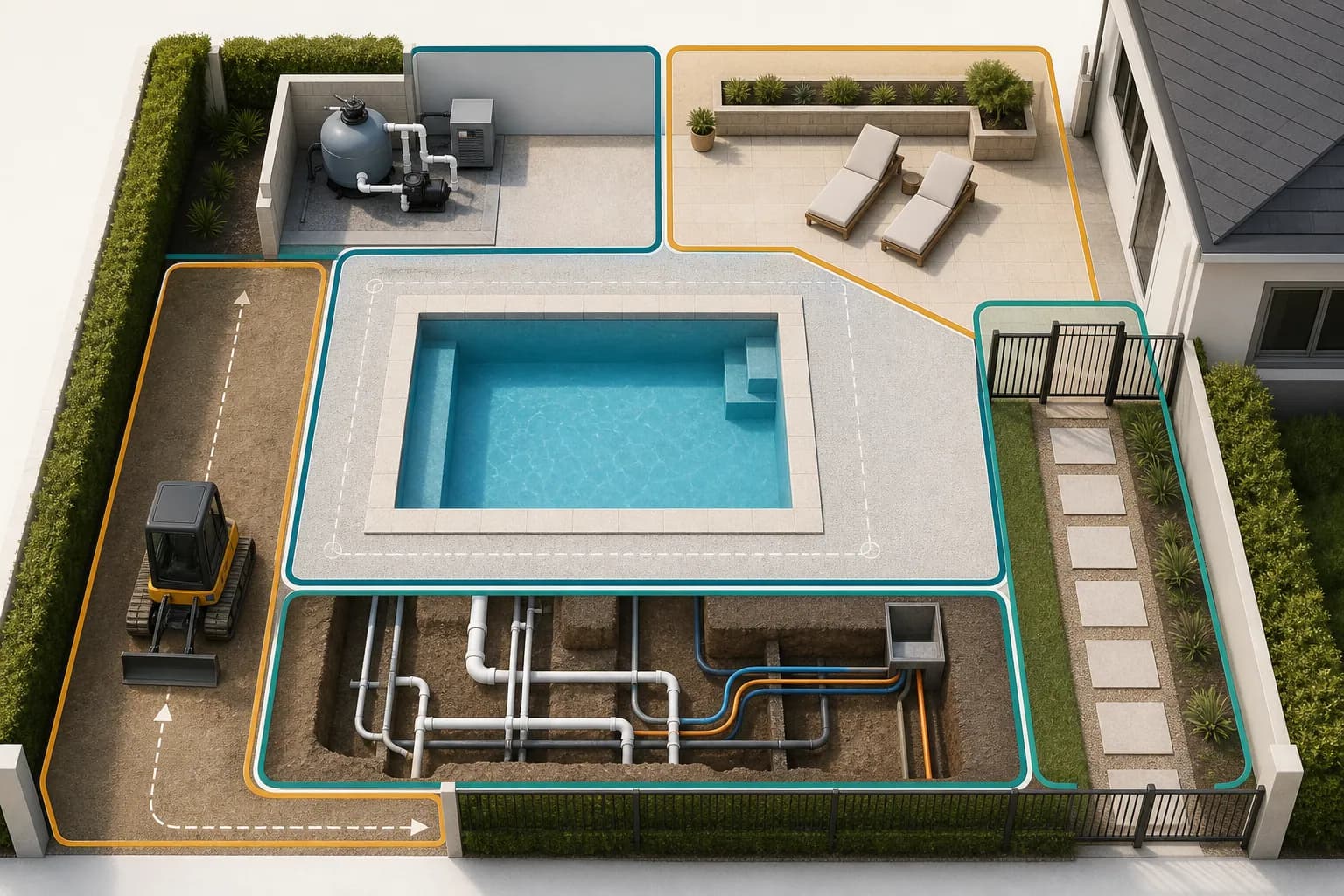
Check room for the water, structure, deck, equipment, cover and access protection. Measure the gate and the entire construction access route. Soil, groundwater, slopes and existing services may change both your choice of pool and the installation cost. An empty patch of lawn is not enough of a site assessment.
If a supplier gives a final price without inspecting the site or stating clear assumptions, ask how site preparation was calculated. An early estimate is reasonable. What matters is identifying which costs are estimates, the unit rate for extra work and who confirms that it is necessary.
Send the same brief to every supplier. You will then receive responses to the same requirements, rather than three different proposals that are difficult to compare. If one contractor recommends a different solution because of site conditions, ask why and check whether that finding affects the other quotations too.
Compare quotations only when they cover the same work
One quotation may include excavation, spoil removal, the base, assembly, pipework and commissioning. Another may cover only the pool and basic equipment. The lower figure does not necessarily mean better value. List each item in a table, showing whether it is included, who provides it and whether the price is fixed or estimated.
Ask for the exact model of pump, filter, heater, cover and water-treatment equipment. Descriptions such as powerful pump or complete filtration system cannot be checked. The model, flow under real operating conditions, required connections, warranty and availability of replacement parts matter more than a large catalogue figure.
Check the construction and finishing work. Who sets the levels, prepares the base, designs drainage, provides electrical protection and restores the garden? If each trade is responsible only for its own part, someone must coordinate the whole installation and approve progress to the next stage.
Include costs beyond the first season: electricity, water, chemicals, servicing and eventual replacement of filter media, covers or the pool membrane. You do not need to predict every bill, but you should understand which parts have a limited service life and how readily servicing and spares are available.
Agree timescales, payments and responsibilities in writing
The agreed pool and equipment models, drawings, technical specification and quotation should form part of the contract. If there are several versions of a quotation, identify the one that applies. A verbal promise of a better pump, extra light or finished deck can be difficult to establish once work begins.
Set deadlines for clear stages and realistic conditions. Rain or unexpected ground conditions may reasonably alter the schedule, but the contract should explain how changes are reported and documented. Payments tied to completed, verifiable stages give you more control than a large deposit without a detailed specification.
The warranty should explain who covers the shell or structure, equipment and installation, and what maintenance the owner must perform to keep the cover valid. Check whether a named company must carry out regular servicing and what counts as misuse. A long warranty with unclear exclusions is not necessarily better than a shorter, understandable one.
Agree a written process for extra work: describe the problem, proposed solution, price and effect on the schedule before it starts. Urgent action to prevent damage may be an exception, but should not become the normal way to expand the job. The contractor should not spend your contingency allowance without your prior approval.
Check operation and collect the documents at handover
Before accepting the completed work, check the pump, filter, valves, heater, lights and water-treatment equipment. Record the clean-filter pressure and initial settings. Look for leaks and confirm that water flows normally through the planned suction and return points.
Ask for instructions and warranties for every item, an installation diagram and photographs of pipes, cables and drainage before backfilling. Valve labels should match the diagram. Without these records, later servicing often starts with guesswork and unnecessary digging.
Arrange a demonstration of filter cleaning, winterising, restarting and safe chemical handling. You should know which checks to carry out regularly and whom to contact when results are outside the expected range. Practical training at commissioning makes it easier to use the equipment and maintain the water correctly later.
Pause if a seller pressures you to pay, avoids specifying models, refuses a site visit or will not put responsibilities in writing. One warning sign does not prove the work will be poor, but several justify checking references and getting another quotation. Delaying the start is better than dealing with the consequences of a pressured decision.