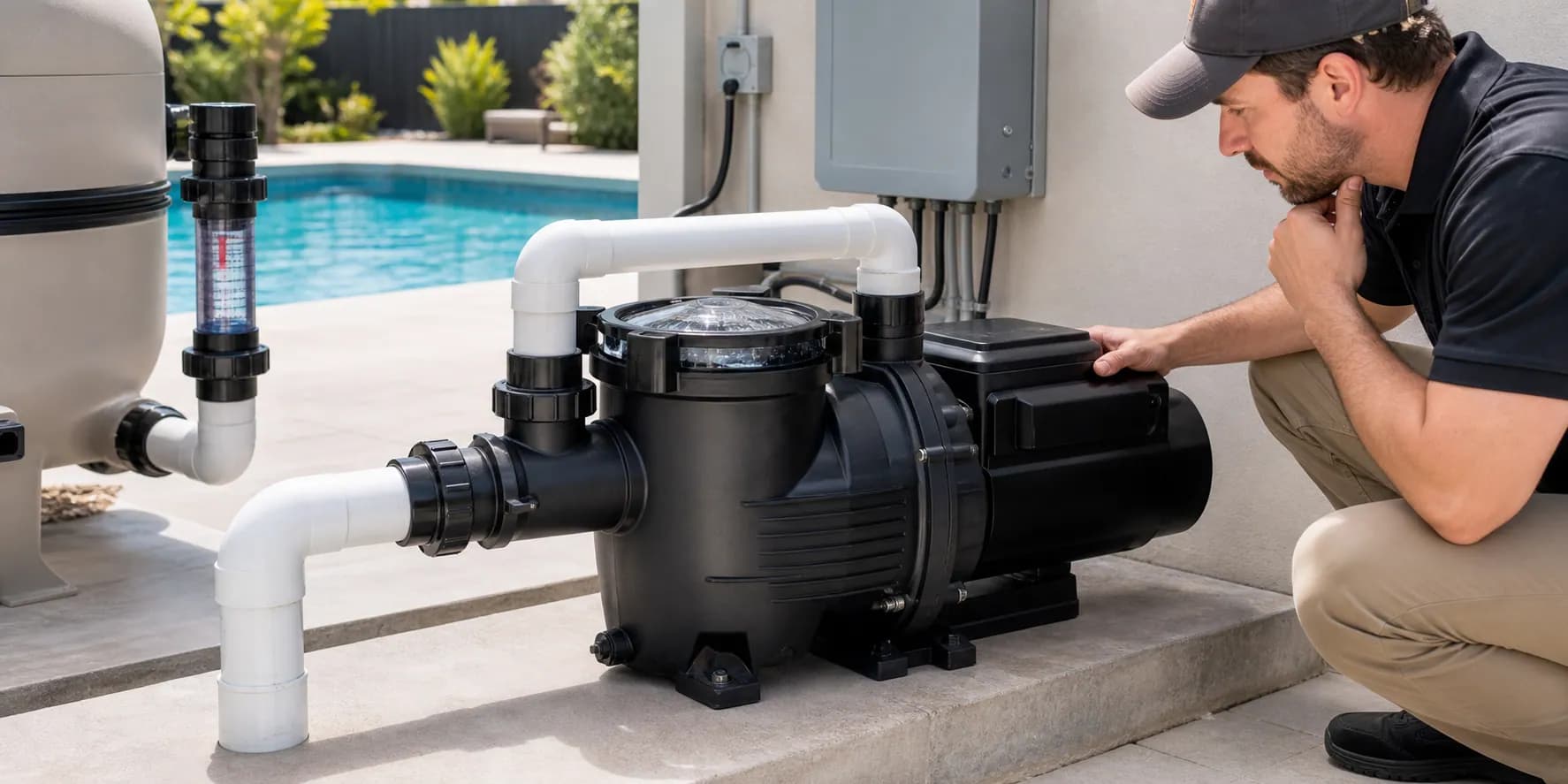
An initial flow calculation is not enough to select a pump model. Pipes, elbows, valves, the filter and other equipment add resistance, so installed flow is usually below the highest catalogue figure. Check the pump curve, the filter's permitted flow and the conditions in your installation.
Written and edited by: Pool Explained editorial team
What flow rate does a pool pump need?
Divide pool volume by the hours allowed for one approximate turnover. For 20 m³ over five hours, the actual flow must be at least 4 m³/h; for 50 m³ over the same period, 10 m³/h. This is a starting point for selection, not a number to copy unquestioningly from the box.
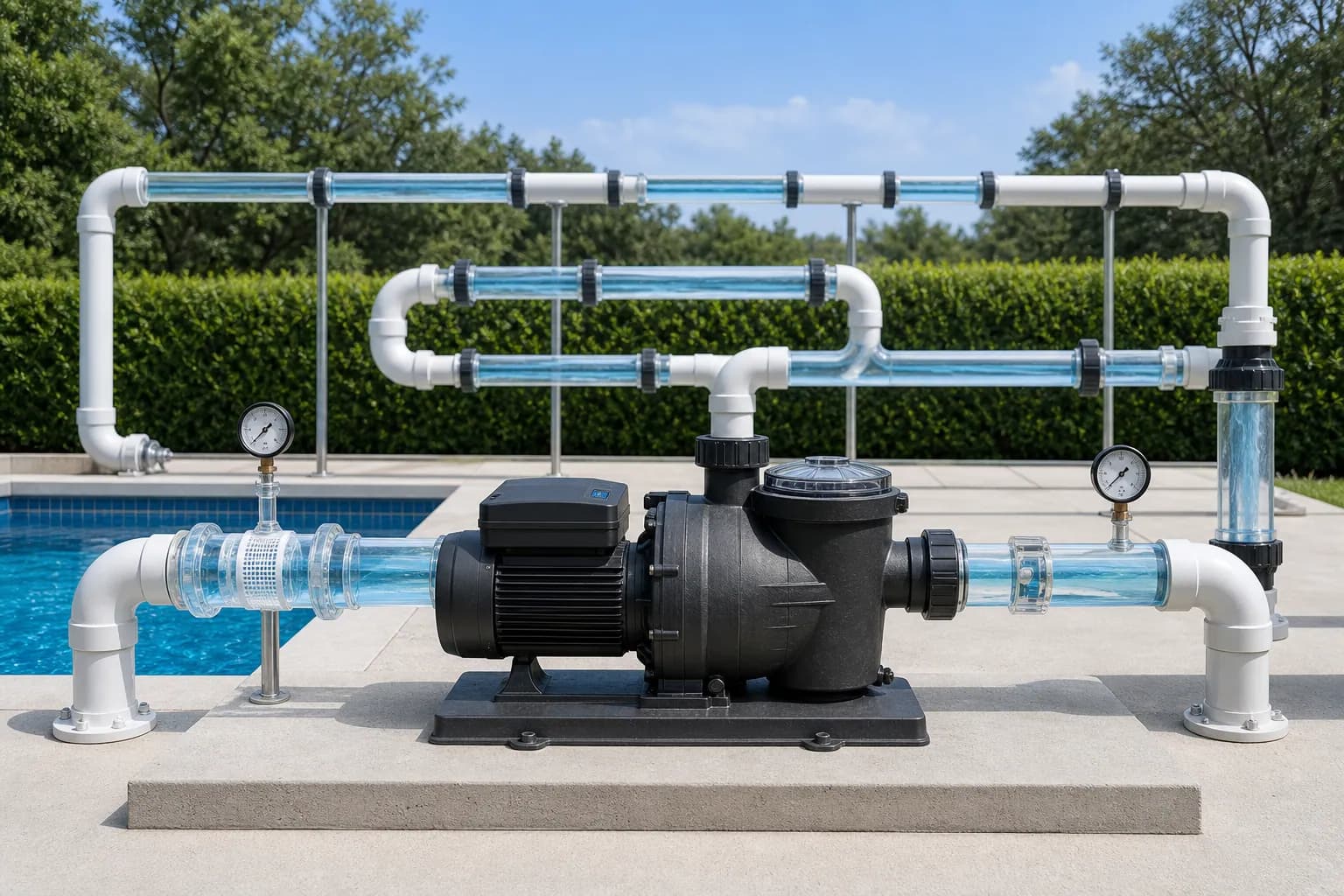
Manufacturers publish a pump curve showing flow at different levels of system resistance. Maximum flow is usually quoted at very low resistance and is not a guaranteed result in your pool. Check the flow delivered under conditions similar to your installation and whether it suits the filter, heater and pipe sizes.
Choosing for a small above-ground pool with short hoses is simpler, but even a factory kit may offer only just enough capacity. A cartridge that dirties quickly can noticeably reduce flow. An in-ground pool with multiple skimmers, a vacuum connection, heating or water features needs a hydraulic calculation. Guessing can lead to expensive pump replacement or altered pipework.
Check the filter's permitted flow
The filter specifies its permitted flow. Do not drive more water through it than the manufacturer allows: excessive speed can reduce fine-particle capture and load the housing and valve. Too little flow, however, makes surface skimming less effective and may fall below the minimum required by a heater, chlorinator or other equipment.
A pump and filter are not necessarily well matched simply because they are sold together. Their specifications must be compatible, and the filter needs enough area for the expected debris. A larger filter often dirties more slowly and needs less frequent cleaning. That is usually more useful than extra motor power pushing dirt faster towards an undersized filter.
For an existing pool, record clean-filter pressure and observe the jets. Weaker returns after several days often mean the filter is dirty, not that the pump has suddenly lost power. Inspect the element in a cartridge filter; with sand, compare pressure to the normal reading and backwash when genuinely needed.
When is a variable-speed pump worthwhile?
A variable-speed pump lets you adjust flow for the task. Lower speed over a longer period is often sufficient for daily filtration, while vacuuming, backwashing or certain equipment may require higher speed. This can be quieter and more energy-efficient than constant full-speed operation.
Do not choose a low speed at random. The skimmer must still collect surface debris, the heater must receive adequate flow and water must circulate throughout the pool. Start with the designer's or manufacturer's recommendation, then monitor clarity, filter pressure and connected equipment. A flow meter makes adjustment much more reliable.
Compare energy use, noise, controls and servicing availability. Programmes and an app add little if spares are unavailable or the basket is difficult to reach. A pump may run for hundreds or thousands of hours each season, so electricity consumption and straightforward maintenance can matter more than a small difference in purchase price.
Where to put the pump and how much space to leave
Install the pump in a dry, ventilated space protected from flooding, rain and direct sun, not a cramped box without cooling. A shorter, simpler suction line makes priming easier. Suction-side joints must be airtight: even a small air leak can cause bubbles, reduced flow and noise.
Leave room to open the lid, remove the basket and reach valves. Label pipes and valves and photograph their normal positions. If a problem develops later, checking what changed is easier than guessing how the system used to operate. Electrical connections, protective devices and bonding must be installed by a qualified person.
Before buying, request the pump curve, noise and energy-use data, warranty conditions and local servicing details. If a contractor proposes a model, ask them to explain expected flow in your installation and whether the filter and other equipment permit it. Saying a pump is powerful enough for a given pool volume is not sufficient.
What to check before buying a pool pump
The quotation should state the exact model, connection sizes, pump curve and conditions used to estimate flow. Ask whether it is self-priming, what motor protection it has and its water-temperature and water-quality limits. Motor power and a general pool-volume recommendation are not enough to compare two pumps.
For a variable-speed pump, check the speeds needed for filtration, heating, vacuuming and backwashing. Lower speed generally reduces noise and energy use, but must still provide enough flow for the equipment operating at that time. Ask the installer to record each mode's settings rather than leaving the pump at maximum speed all season.
When the pump starts, check that the basket is full of water without persistent bubbles, the sound is steady and returns are even. Record the operating mode and consumption if measurable. A changed sound, frequent loss of water from the housing or weaker jets warrants checking levels, baskets, valves, the filter and suction-side joints.
Switch off immediately if the pump runs dry, overheats, leaks near electrical parts or repeatedly trips protection. Do not keep restarting it hoping the motor will recover. If basic checks reveal no cause, give a technician the model, operating mode and details of what changed. A precise description can shorten diagnosis and repair.